
Mastering AI-Driven Structural Translation: From Simple Flowcharts to BPMN with VPasCode
In the modern landscape of software architecture and business process modeling, the ability to communicate complex logic is paramount. However, different stakeholders require different levels of abstraction. Executives often need high-level overviews, while developers require granular, standard-compliant technical specifications. This is where AI-Driven Structural Translation becomes a game-changer.
This tutorial explores the architecture behind AI Modify’s type conversion capabilities within Visual Paradigm’s VPasCode environment. We will examine how the system preserves business logic, ensures syntax compliance, and facilitates iterative refinement, allowing you to transform simple diagrams into professional standards like BPMN or C4 without losing your original intent.
The Architecture of Structural Translation
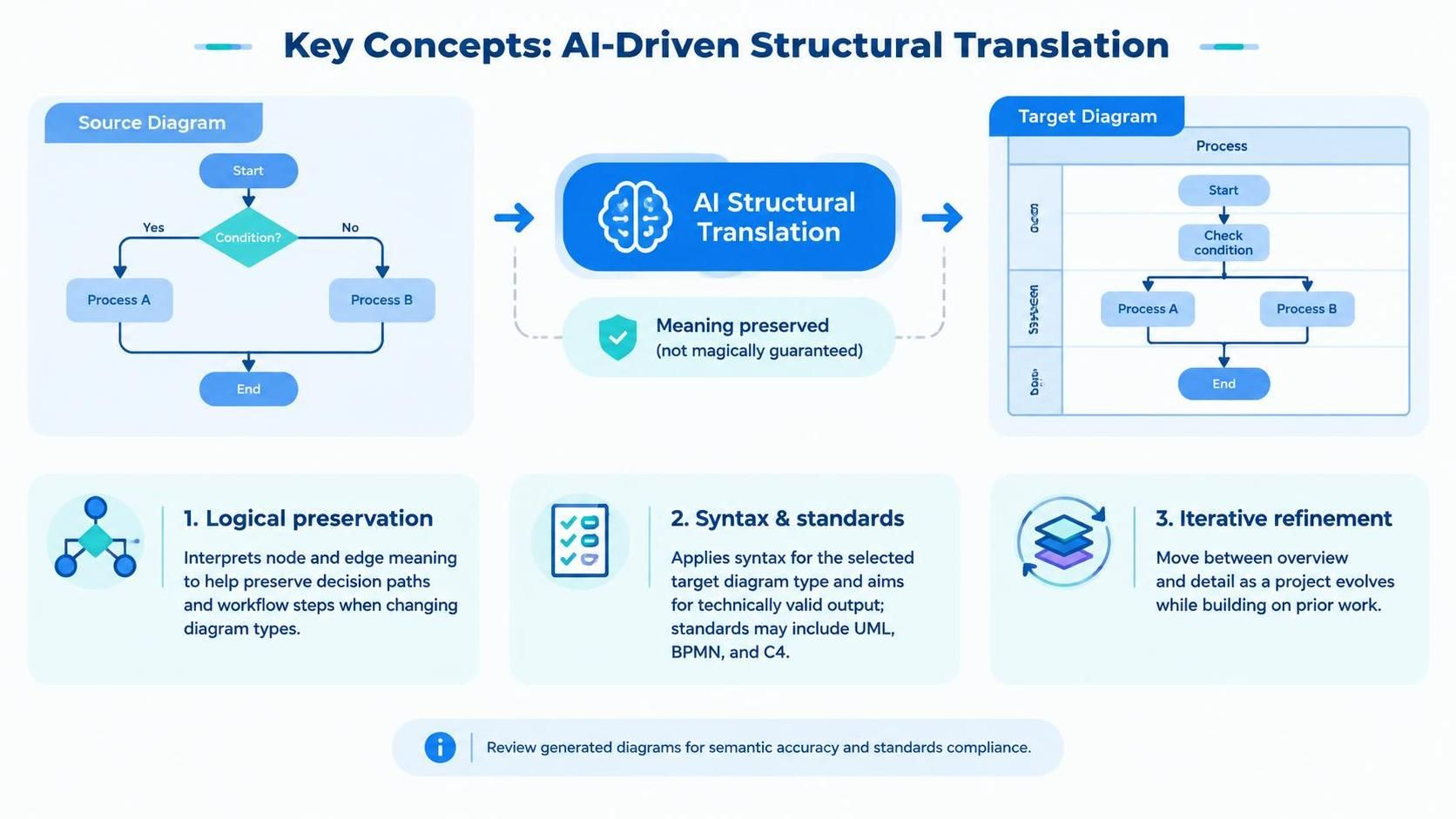
The core of this AI-driven approach is the ability to interpret the semantic meaning of a diagram rather than just its visual appearance. The process flows from a Source Diagram (typically a simple flowchart) through an AI Structural Translation engine to a Target Diagram (such as a BPMN Process).
This transformation is not a mere cosmetic change. It is a logical mapping process that re-engineers the diagram’s structure while maintaining the integrity of the underlying workflow.
1. Logical Preservation: The Semantic Core
The primary challenge in converting diagram types is maintaining the integrity of the business logic or process flow. AI Modify does not just change the visual appearance; it interprets the semantic meaning of your nodes and edges.
Whether you are converting a linear process into a parallel activity or a simple sequence into a complex state machine, the AI ensures that the original decision paths and workflow steps remain intact. This ensures that the “meaning” of the diagram is preserved, even as the notation changes.
2. Syntax and Standard Compliance
Different diagram types adhere to specific standards, such as UML, BPMN, or C4. Manually ensuring compliance with these standards requires deep knowledge of syntax rules. For instance, a BPMN diagram requires specific gateways and event types that differ significantly from a standard flowchart.
AI Modify automatically applies the correct syntax for the target diagram type. This ensures that your output is not only visually accurate but also technically valid for professional documentation. It handles the heavy lifting of standard compliance, ensuring your diagrams are ready for review by industry experts.
3. Iterative Refinement
Diagramming is an iterative process. You might start with a high-level overview and later need to drill down into specific technical details. AI Modify allows for seamless transitions between levels of abstraction and formality.
This capability enables you to refine your diagrams as your project matures without losing previous work. You can evolve a simple sketch into a rigorous technical model, building upon your prior work rather than starting from scratch.
Practical Application: Transforming a Flowchart
To understand this in practice, let us look at how a simple flowchart with a conditional decision is translated into a BPMN process. The source diagram contains a simple decision diamond, while the target diagram utilizes BPMN gateways and pools.
Below is an example of how this transformation is represented in code (VPasCode), demonstrating the structural shift from a generic flow to a standard-compliant process.
// Source: Simple Flowchart Logic
Start --> Condition{Is Valid?}
Condition -- Yes --> Process A
Condition -- No --> Process B
Process A --> End
Process B --> End

// Target: AI-Driven Structural Translation to BPMN
@startuml
skinparam bpmnBackgroundColor #ffffff

start
:Check Condition;
if (Is Valid?) then (Yes)
  :Process A;
else (No)
  :Process B;
endif
:End;
stop
@enduml
In this scenario, the AI interprets the Condition node and ensures that the resulting BPMN diagram correctly represents the branching logic using appropriate syntax, ensuring the output is valid for technical documentation.
Best Practices for AI-Enhanced Modeling
When utilizing AI-driven structural translation, it is important to remember that the AI acts as a powerful assistant, not a replacement for human oversight. While the AI preserves logic and ensures syntax, the context of your specific business domain is unique.
- Review Generated Diagrams: Always review generated diagrams for semantic accuracy. Ensure that the translated logic truly reflects your business requirements.
- Iterate Gradually: Use the AI to move between high-level and low-level views, but verify the details at each stage.
- Leverage Standards: Take advantage of the automatic syntax compliance to ensure your diagrams meet industry standards like BPMN 2.0 or UML 2.5.
Conclusion
By leveraging AI-driven structural translation, you can streamline the modeling process, ensuring that your diagrams are not only visually appealing but also technically robust and logically sound. This approach empowers teams to focus on the “what” and “why” of their processes, while the AI handles the “how” of standard compliance and structural translation.
As you continue to refine your diagrams, remember that the goal is to create clear, effective communication tools. With AI Modify, you have the power to adapt your models to any audience, from high-level stakeholders to technical architects, without losing the essence of your original design.