
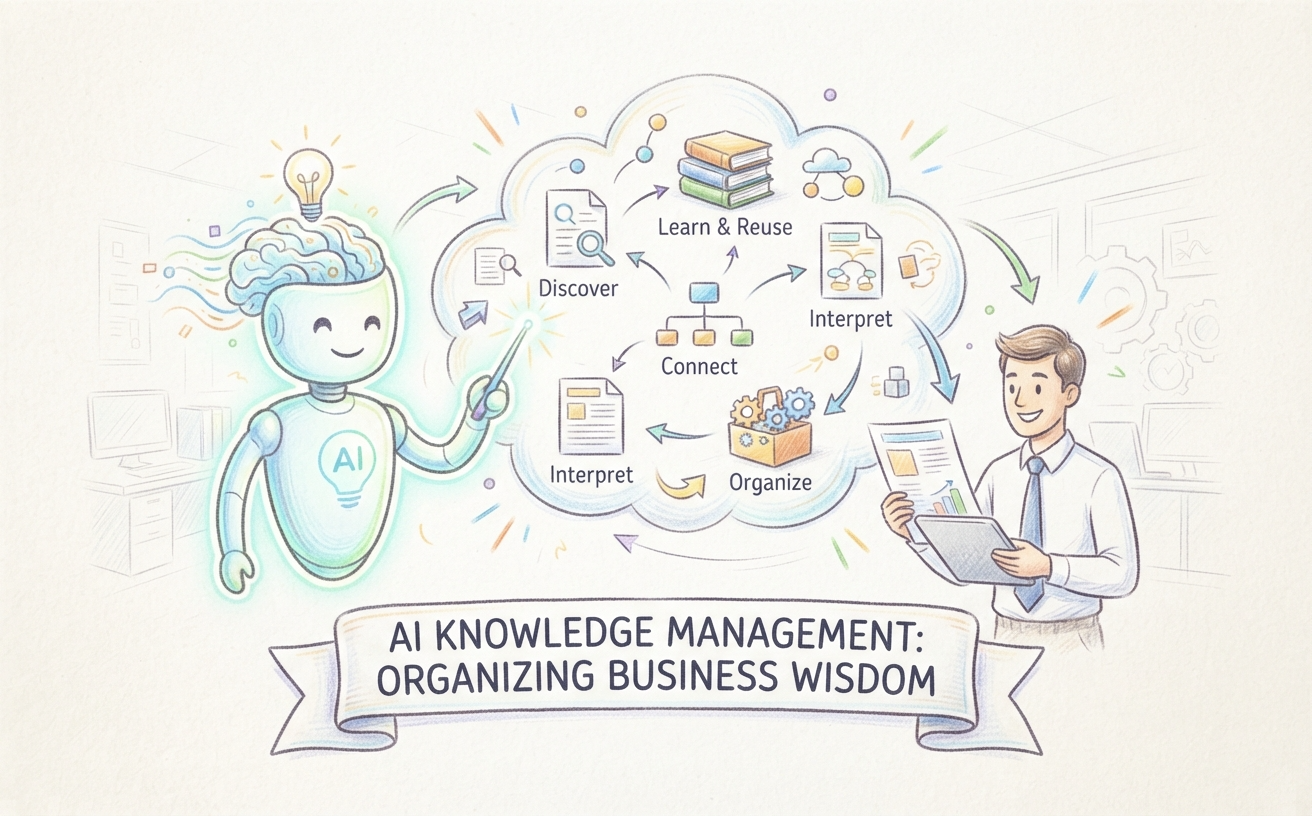
Every organization accumulates knowledge as it operates. Employees learn how processes work, teams document project decisions, departments develop specialist expertise, and managers build an understanding of customers and business operations.
Yet much of this knowledge is difficult to access when it is needed. Important information may be scattered across documents, emails, meeting notes, shared folders, and individual employees’ experience. Even when a company has a document repository or intranet, employees may struggle to find the right information or understand how different pieces of knowledge relate to one another.
AI knowledge management offers a way to address this challenge. By combining knowledge organization practices with AI capabilities, businesses can make their accumulated information easier to discover, understand, and reuse.
This guide explains what AI knowledge management is, how it works, where it can help, and what organizations should consider when introducing it.
What Is AI Knowledge Management?
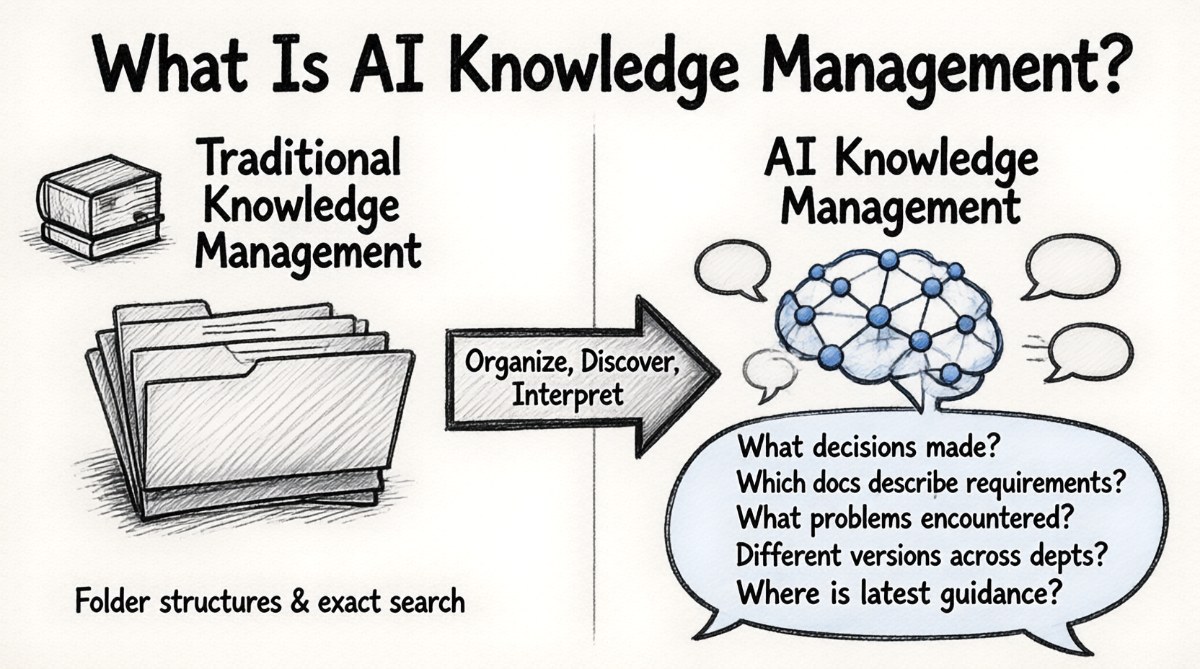
AI knowledge management is the use of artificial intelligence to help an organization organize, discover, interpret, connect, and reuse its knowledge.
Traditional knowledge management focuses on capturing and maintaining organizational information so that people can access it when needed. This may involve document repositories, knowledge bases, intranets, internal wikis, training materials, and established processes for sharing expertise.
AI extends these practices by making it possible to interact with information in more flexible ways. Instead of relying entirely on folder structures, document titles, or exact search terms, employees may be able to ask questions in natural language, request summaries, compare information, and explore relationships across multiple sources.
For example, an employee joining a project might ask:
- What decisions have already been made about this project?
- Which documents describe the current business requirements?
- What problems were encountered during the previous implementation?
- Are there different versions of the procedure across departments?
- Where can I find the latest approved guidance?
An AI-powered knowledge system can help locate relevant information and present it in a more accessible form, provided that the necessary sources have been connected and the system is configured appropriately.
The objective is not simply to store more information. It is to make existing knowledge more useful to the people who need it.
Why Traditional Knowledge Management Is Not Always Enough
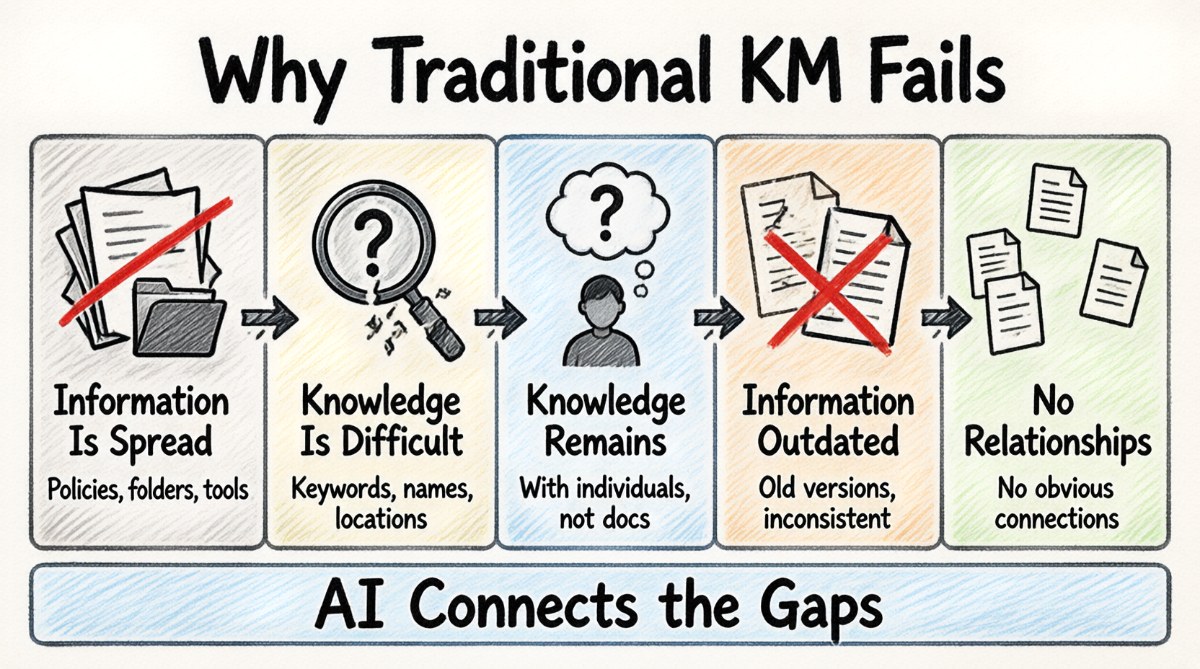
Many organizations already have systems for storing and sharing information. However, having a place to keep documents does not necessarily mean employees can find or use the knowledge inside them.
Several common problems explain why organizational knowledge remains difficult to access.
Information Is Spread Across Different Locations
Business knowledge rarely exists in one neatly organized system. Policies may be stored in an intranet, project documents in shared folders, meeting records in collaboration tools, and technical guidance in separate documentation platforms.
Employees may need to search several locations to answer a single question. They may also be unaware that relevant information exists elsewhere in the organization.
Knowledge Is Difficult to Find
Traditional search often depends on employees knowing the right keywords, document names, or folder locations. This creates a problem when someone understands what they need but does not know how the information was originally recorded.
For example, an employee may want to know why a particular business rule was introduced. Searching for the exact phrase used in an old meeting record may not reveal the relevant discussion or decision.
Important Knowledge Remains with Individuals
Not all organizational knowledge is written down. Experienced employees often understand exceptions, historical decisions, customer expectations, and practical details that are not fully documented.
When these employees change roles or leave the organization, valuable knowledge can disappear with them unless there are deliberate knowledge-sharing and documentation practices.
Information Becomes Outdated or Inconsistent
Procedures, specifications, and business decisions change over time. Without clear ownership and review processes, outdated documents may remain accessible alongside current versions.
Different departments may also maintain separate descriptions of the same process, leading to confusion about which information should be followed.
Documents Do Not Always Explain Relationships
A collection of documents may contain a great deal of useful information without making the connections between them obvious. A project decision may relate to a requirement, a customer issue, and a later design change, but employees may have to discover those relationships manually.
AI can help explore relationships across information sources, although the results still depend on the completeness and quality of the available material.
How AI Improves Knowledge Management
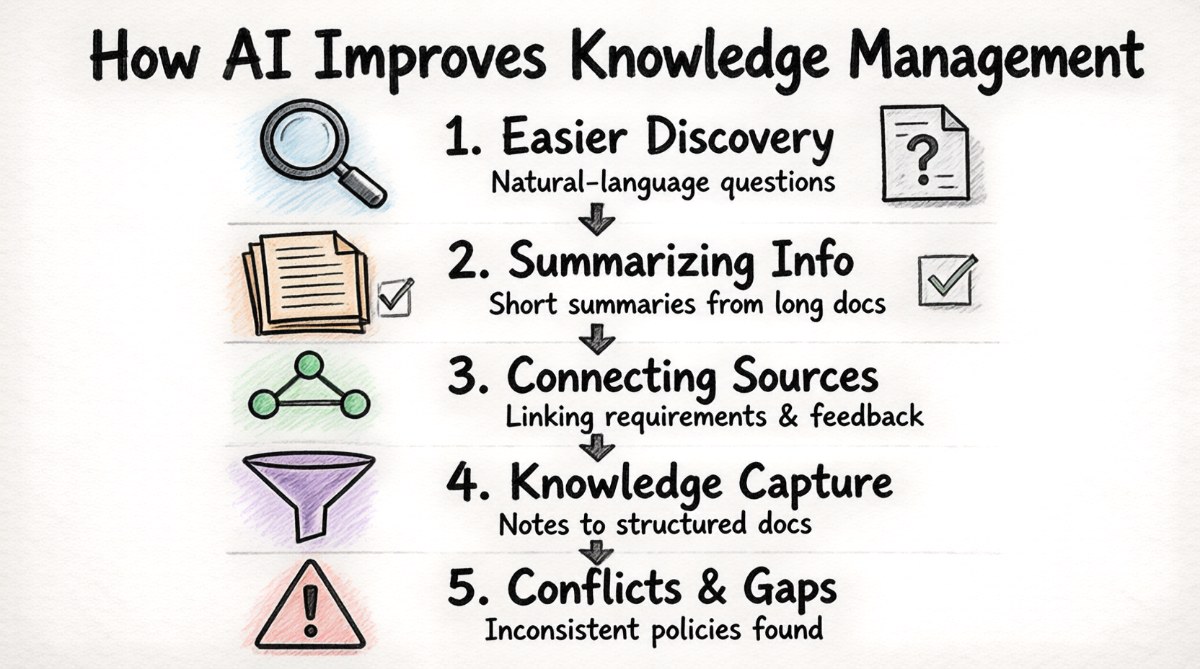
AI can support several stages of the knowledge management lifecycle. It does not replace the need for good information practices, but it can make organizational knowledge more accessible and easier to work with.
1. Making Knowledge Easier to Discover
Natural-language question answering allows employees to describe what they need rather than relying only on exact keywords.
For example, someone could ask, “What is the process for approving a new supplier?” The system may retrieve relevant procedures and provide a concise explanation based on the available documentation.
This can reduce the time employees spend navigating folders, opening multiple files, and searching through lengthy documents.
2. Summarizing Large Amounts of Information
AI can help employees understand lengthy documents, reports, and collections of notes by producing summaries and highlighting important points.
A manager reviewing several project reports might ask for a summary of recurring challenges. A new employee might request a simplified explanation of a technical document. A team leader might want the key decisions extracted from a series of meeting records.
Summaries can make information easier to consume, but employees should still refer to the original material when details, context, or formal approval matter.
3. Connecting Information Across Sources
One of the more valuable opportunities is helping employees explore connections between different pieces of organizational knowledge.
Consider a product development project. Its requirements may be recorded in one document, design decisions in another, testing observations in a third, and stakeholder feedback in meeting notes.
An AI-powered system with access to these sources may help answer questions that involve more than one document, such as identifying which requirements were affected by a particular decision.
Such analysis can help teams develop a more complete understanding of their work instead of treating every document as an isolated record.
4. Supporting Knowledge Capture
Knowledge management is not only about finding existing information. Organizations also need to capture new knowledge as work progresses.
AI can assist with turning informal information into more structured material. For example, it may help transform meeting notes into summaries, extract action items, organize observations, or draft documentation from written descriptions.
This can make it easier for employees to contribute useful knowledge without requiring everyone to become a professional technical writer.
However, employees should review the resulting content, confirm important details, and ensure that the information is stored in an appropriate location.
5. Identifying Possible Conflicts and Gaps
Organizations sometimes maintain documents that contain different descriptions of the same policy, requirement, or process. These differences may reflect legitimate changes, departmental variations, or outdated information.
AI can help compare documents and highlight statements that appear inconsistent. It may also identify topics that are mentioned frequently but lack clear supporting documentation.
These findings can help knowledge managers and subject matter experts decide what needs clarification or review. AI should not independently determine which policy is authoritative or resolve organizational disagreements.
Practical Examples of AI Knowledge Management
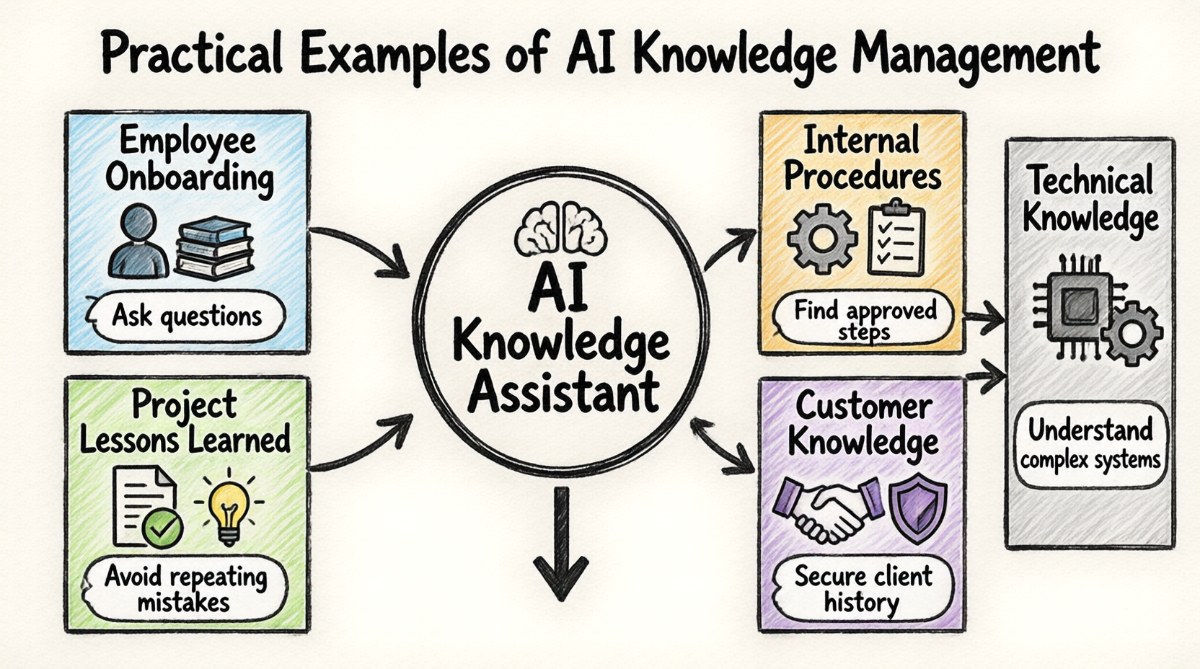
The value of AI knowledge management becomes clearer when considered in everyday business situations.
Employee Onboarding
New employees often need to learn company policies, procedures, organizational structures, and the history of ongoing work.
An AI-powered knowledge assistant can help them find relevant information and ask questions as they become familiar with their responsibilities. Instead of relying exclusively on colleagues to answer recurring questions, employees can use an approved knowledge repository as an additional learning resource.
Human guidance remains important, especially for role-specific training, sensitive decisions, and situations that require practical experience.
Project Knowledge and Lessons Learned
Project teams generate knowledge throughout the project lifecycle. Requirements, meeting notes, decisions, risks, changes, and lessons learned can all become valuable references for future work.
AI can help teams summarize project history, locate previous decisions, and retrieve lessons from earlier initiatives. This can reduce the risk of repeating mistakes or overlooking relevant experience.
Internal Procedures and Company Guidelines
Employees may need to consult internal instructions when handling routine activities. AI can make approved procedures easier to find and explain, particularly when information is spread across several documents.
For example, an employee could ask what steps are required to request a purchase approval. The system may retrieve the relevant instructions and summarize the process.
Any answer should remain grounded in current, approved documentation. AI should not create new company policies or authorize exceptions.
Customer and Client Knowledge
Sales, consulting, and customer service teams accumulate knowledge through conversations, proposals, project records, and customer feedback.
An appropriately controlled knowledge system can help authorized employees retrieve relevant engagement history, understand recurring customer concerns, and reuse approved internal expertise.
Organizations handling client information must pay particular attention to confidentiality, access permissions, retention requirements, and separation between different clients’ records.
Technical and Product Knowledge
Technical teams often work with specifications, architecture documents, system descriptions, troubleshooting records, and product documentation.
AI can help developers and engineers locate relevant material, understand complex explanations, and explore documented relationships between system components or requirements.
This can be particularly helpful when employees need to understand systems that have evolved over many years or were originally documented by people who are no longer on the team.
What Does an AI Knowledge Management System Need?
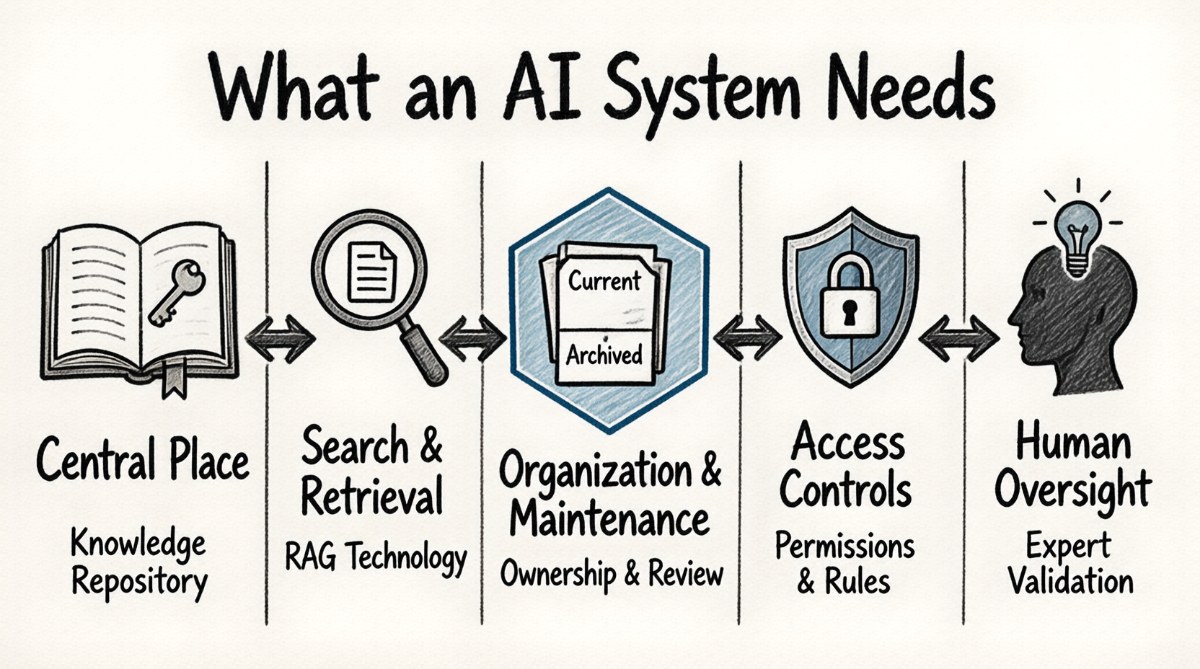
A useful AI knowledge management system involves more than connecting a chatbot to a folder of documents. It needs a combination of information management practices, AI capabilities, and appropriate controls.
A Central Place for Organizational Knowledge
Organizations need a manageable way to collect and maintain relevant information. This may involve a dedicated knowledge repository, document management platform, internal wiki, or a combination of connected sources.
The important point is to establish where information belongs and how employees can identify authoritative material.
Search and Retrieval Capabilities
The system needs a way to identify relevant information when employees ask questions. Some AI knowledge systems use retrieval-augmented generation (RAG), which retrieves relevant content and provides it to a language model as context for generating an answer.
Retrieval quality is important. If the system retrieves incomplete, outdated, or unrelated material, the generated response may be misleading even when the language model itself is capable.
Knowledge Organization and Maintenance
Documents should have appropriate ownership, titles, descriptions, and review practices. Where necessary, organizations should distinguish current approved material from historical records, drafts, and archived content.
AI may assist with classification, summarization, and content discovery, but responsibility for maintaining authoritative information should remain clear.
Access Controls
Not every employee should have access to every piece of company knowledge. An AI system must respect the organization’s information access rules and should not expose restricted content through generated answers.
Permissions need to be considered across the full information flow, including document retrieval, user access, application integrations, and administrative functions.
Human Oversight
AI-generated summaries, explanations, and analysis should be treated as assistance rather than automatic approval. Subject matter experts and information owners remain responsible for validating important content and maintaining official records.
How to Introduce AI Knowledge Management in Your Organization
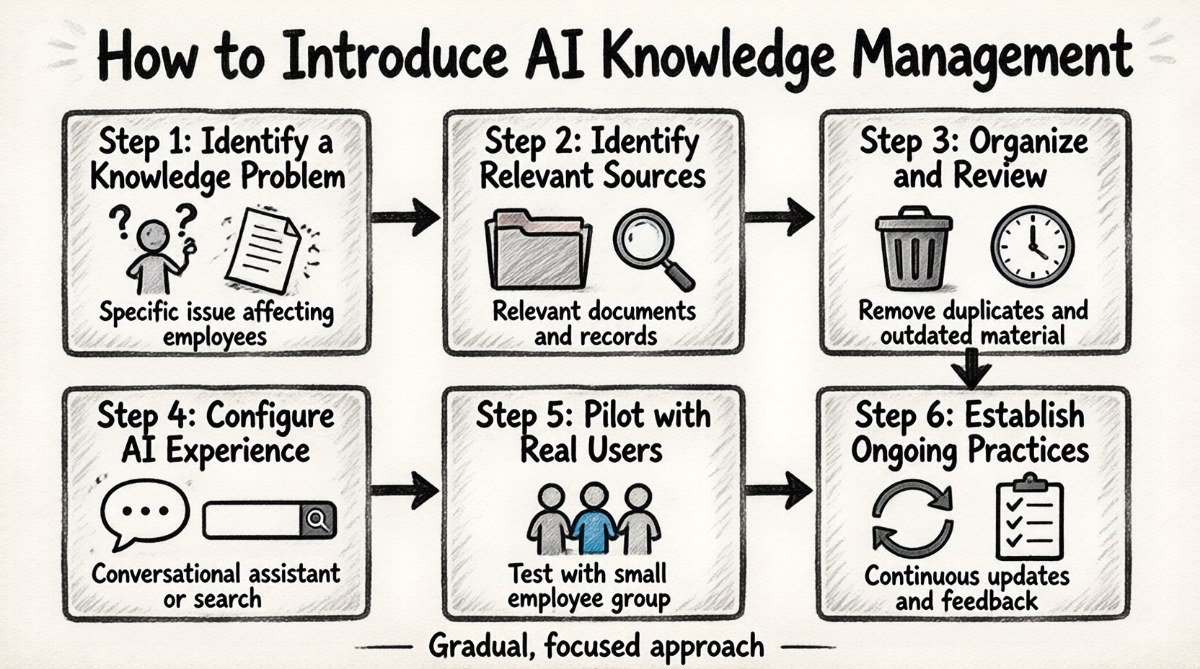
Introducing AI knowledge management does not require an organization to transform every information system at once. A focused, gradual approach is often more practical.
Step 1: Identify a Knowledge Problem
Start with a specific issue that affects employees. Perhaps people cannot find current procedures, project knowledge is difficult to reuse, or important information is spread across several departments.
Choose a problem that is meaningful enough to justify improvement but manageable enough to address in an initial project.
Step 2: Identify the Relevant Knowledge Sources
Determine which documents, notes, records, and other sources contain the information needed for the selected use case.
Do not assume that every available document should be connected immediately. Start with relevant, appropriate material and consider its accuracy, ownership, sensitivity, and current status.
Step 3: Organize and Review the Information
Before introducing AI, review the selected knowledge sources. Remove unnecessary duplicates where appropriate, identify outdated material, clarify ownership, and establish how authoritative versions will be maintained.
This step is important because AI cannot reliably compensate for poorly managed information.
Step 4: Configure the AI Experience
Choose how employees will interact with the knowledge. This might be through a conversational assistant, a search interface, or AI capabilities embedded in existing business applications.
Define which sources are available to different users and test whether the system retrieves relevant information for realistic questions.
Step 5: Pilot with Real Users
Invite a small group of employees to use the system for actual work. Ask them to try common questions, explore documents, and report answers that are incomplete, confusing, or unsupported.
Measure whether the system helps employees find information more efficiently and whether the answers are useful enough to support the intended tasks.
Step 6: Establish Ongoing Knowledge Practices
AI knowledge management is not a one-time implementation. Organizations need processes for adding new information, reviewing existing content, updating procedures, managing permissions, and collecting feedback.
Assign responsibility for these activities so that the knowledge environment remains useful as the business changes.
AI Knowledge Management Is About More Than Finding Documents
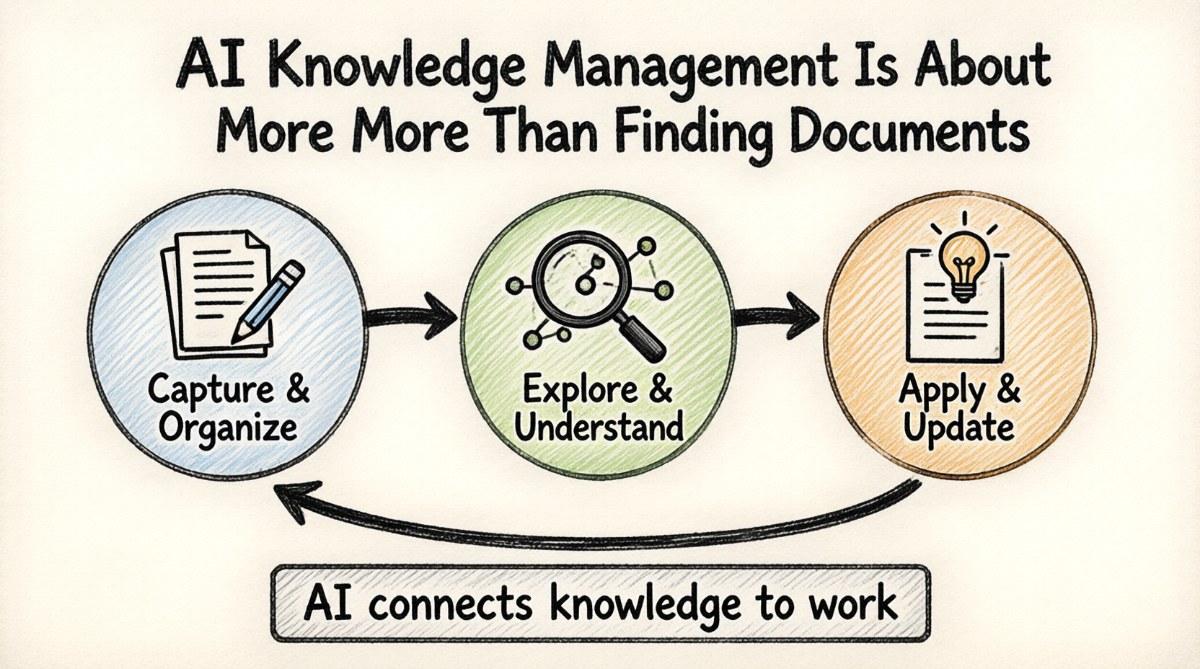
Document search is an important capability, but knowledge management has a broader purpose. It helps organizations preserve what they have learned, share expertise, understand the relationships between information, and apply accumulated knowledge to future work.
For example, a team might use a knowledge repository to collect meeting notes and project documents. An AI assistant could then help identify recurring stakeholder concerns, summarize decisions over time, or locate information relevant to a new requirement. The team could use those findings to prepare a report, update documentation, or create a visual model.
This creates a practical cycle: knowledge is captured, organized, explored, applied, and updated as new work produces further insights.
Visual Paradigm’s Private AI for Enterprise Knowledge offering brings together knowledge management, AI-assisted information access, documentation, and visual modeling capabilities. This type of integrated approach can help organizations connect the management of company knowledge with the work employees need to produce from it.
Conclusion
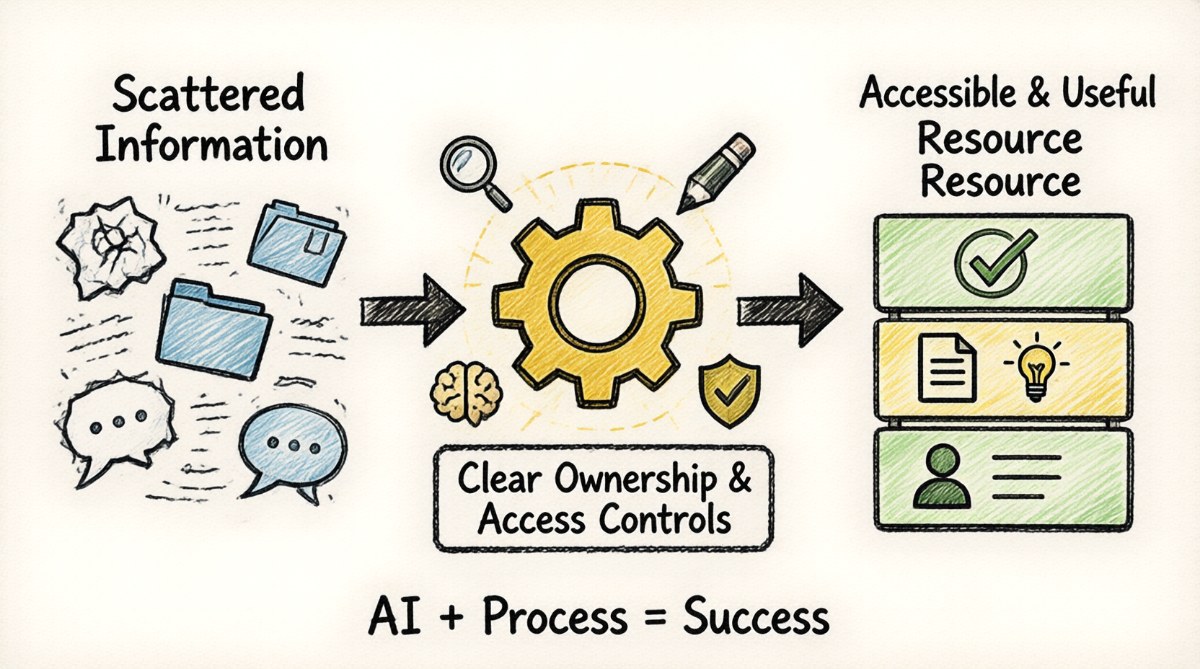
AI knowledge management helps businesses make better use of the information and expertise they already possess. It can make documents easier to discover, simplify complex material, connect related information, support knowledge capture, and help employees learn from previous work.
However, technology alone does not create a successful knowledge management practice. Organizations still need clear ownership, reliable information, appropriate access controls, and processes for maintaining their knowledge over time.
The most effective approach is to begin with a real knowledge-sharing problem, improve the relevant information sources, and introduce AI where it makes that knowledge more accessible and useful. Over time, this can help transform scattered organizational information into a resource that supports everyday work and long-term learning.