


Introduction
In the modern digital landscape, information overload is a pervasive challenge. Professionals, students, and creatives often find themselves grappling with scattered thoughts and complex data sets. Traditional linear note-taking often fails to capture the dynamic nature of human thought. This is where mind mapping—a method of visually organizing information—has always excelled. However, the integration of Artificial Intelligence (AI) has elevated this practice from a manual drawing exercise to a dynamic, generative process.
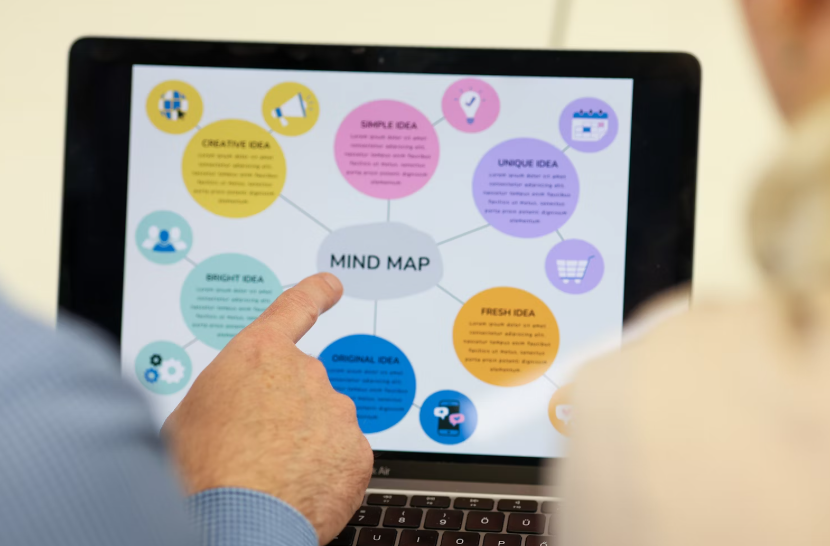
This guide explores how AI-powered mind map generators, such as Visual Paradigm Online, are redefining productivity. By automating the structural heavy lifting, these tools allow users to focus on high-level strategy and creative synthesis rather than formatting and layout.
Key Concepts and Terminology
To fully leverage AI-enhanced visualization, it is crucial to understand the foundational concepts that drive this technology:
- Mind Map: A diagram used to visually organize information into a hierarchy, showing relationships among pieces of the whole. It is often created around a single concept, drawn as an image in the center of a blank page.
- Node: The individual points of data in a mind map. The central concept is the “root node,” while specific details branching off are “child nodes.”
- Generative AI: A type of artificial intelligence that can create new content, including text and visual structures, in response to user prompts. In this context, it predicts logical sub-topics and associations.
- Visual Hierarchy: The arrangement of elements in a way that implies importance. AI tools automatically organize nodes to ensure the most critical information stands out.
Why Mind Mapping Matters in the AI Era
Historically, creating a mind map required starting with a blank canvas. This “cold start” problem often hindered productivity; users would spend valuable time drawing branches and color-coding before developing their core ideas. AI removes this friction through several key mechanisms:
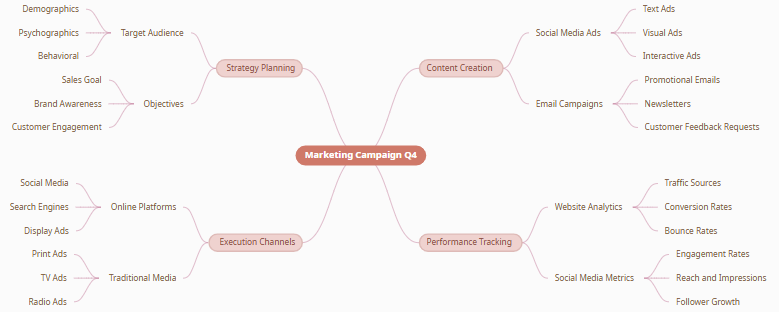
- Instant Structure: The AI algorithms analyze the semantic meaning of a central topic and immediately generate a logical framework, eliminating the fear of the blank page.
- Enhanced Creativity: By suggesting relevant sub-topics and lateral connections, AI acts as a collaborative partner, surfacing ideas the user may not have initially considered.
- Effortless Refinement: Design and aesthetics are handled automatically. Users can customize layouts and color schemes in seconds without requiring graphic design skills.
How It Works: The 3-Step Visualization Process
Tools like Visual Paradigm Online have streamlined the creation process into three distinct, intuitive steps that bridge the gap between abstract thought and concrete visualization.
Step 1: Input Core Concept
The process begins with a prompt. The user inputs a central idea, which serves as the seed for the AI’s analysis. Modern AI models are capable of understanding a vast array of contexts, including:
- Business contexts: “Q3 Marketing Strategy” or “New Product Development Pipeline.”
- Academic subjects: “Biology 101: Cell Structure” or “Shakespeare’s Major Themes.”
- Personal planning: “Home Renovation Plan” or “Career Development Goals.”
Step 2: AI Generation and Processing
Once the prompt is received, the system analyzes the input to identify key themes and potential connections. Within seconds, the AI:
1. Establishes the central node.
2. Extrapolates primary branches representing fundamental categories.
3. Populates secondary branches with specific, actionable sub-topics.
4. Suggests cross-links between branches to highlight interdependencies.
Step 3: Refine and Enhance
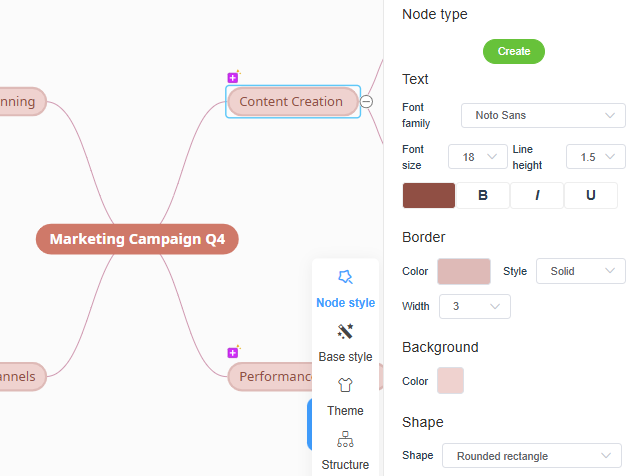
The final step puts the user back in control. While the AI builds the skeleton, the user adds the flesh. This involves dragging and dropping nodes to reorganize logic, color-coding branches for visual clarity, and adding specific notes or icons. This phase transforms a generic AI output into a tailored professional document. Users can customize layouts to better suit their specific presentation needs.
Comparison: Manual vs. AI-Powered Mind Mapping
The following table outlines the operational differences between traditional manual methods and modern AI-assisted approaches.
| Feature | Traditional Manual Mapping | AI-Powered Mapping |
|---|---|---|
| Setup Time | High (drawing, formatting) | Near Instantaneous |
| Idea Generation | Limited to user’s current knowledge | Expanded by AI suggestions and knowledge bases |
| Flexibility | Difficult to restructure once drawn | Drag-and-drop reorganization |
| Collaboration | Static (paper or offline files) | Real-time, cloud-based sharing |
5 Ways AI Mind Maps Supercharge Workflows
Implementing AI visualization can drastically improve efficiency across various domains. Here are five high-impact use cases:
1. Accelerate Brainstorming Sessions
Sticky notes can become chaotic. AI mind maps replace messy walls with organized digital trees. By inputting a central concept during a meeting, teams can instantly view a structured array of themes, making creative sessions more focused and productive.
2. Simplify Complex Planning
For project managers and engineers, breaking down multi-phase projects is critical. AI tools can auto-organize tasks, milestones, and dependencies into a clear hierarchy, ensuring that no aspect of the project scope is overlooked.
3. Enhance Learning & Retention
Educational theory suggests that visual learning aids retention. Students can transform dense textbook chapters or lecture notes into visual diagrams. This process aids in decomposing complex subjects—such as cellular biology or historical timelines—into digestible components.
4. Strengthen Business Strategies
Consultants and executives can utilize AI to quickly visualize frameworks like SWOT analyses (Strengths, Weaknesses, Opportunities, Threats), customer journey maps, or competitive landscapes. This allows for faster decision-making based on a holistic view of the data.
5. Streamline Content Creation
Writers and marketers can defeat writer’s block by using AI to generate comprehensive outlines for blogs, whitepapers, or video scripts. The mind map ensures a logical flow of narrative and ensures all key talking points are covered before drafting begins.
Who Benefits Most?
While applicable to almost anyone, specific professional groups see the highest return on investment from this technology:
- Project Managers: For planning sprints, workflows, and resource allocation visually.
- Marketers: For mapping out complex campaign strategies and content calendars.
- Students & Educators: For simplifying complex curriculum and improving exam preparation.
- Business Leaders: For visualizing strategic roadmaps and decision-making frameworks.
Why Choose Visual Paradigm Online?
Visual Paradigm Online stands out in the crowded field of productivity tools by offering a seamless blend of power and usability. Key advantages include:
- Zero Learning Curve: The interface is designed for immediate use, requiring no technical training.
- Professional Output: The maps generated are aesthetically polished and ready for presentation immediately.
- Cloud-Native Collaboration: Being cloud-based, it supports real-time collaboration, making it ideal for remote or hybrid teams.
- Versatile Export Options: Users can export their visual data into various formats like PDF or PNG, or share via direct links.
Conclusion
In a world where clear thinking and efficient communication are paramount, AI-powered mind mapping represents a significant leap forward. It eliminates the logistical friction of manual organization, allowing users to harness their natural creativity and strategic thinking capabilities fully. Whether for business strategy, academic study, or personal organization, tools like Visual Paradigm Online provide the necessary infrastructure to turn scattered ideas into actionable plans. Now is the time to transition from manual drafting to intelligent, automated visualization.
- AI-Powered Visual Modeling and Design Solutions by Visual Paradigm: Explore cutting-edge AI-driven tools for visual modeling, diagramming, and software design, enabling faster, smarter development workflows.
- Visual Paradigm – All-in-One Visual Development Platform: A comprehensive platform for visual modeling, software design, business process modeling, and AI-powered development tools.
- AI Chatbot Feature – Intelligent Assistance for Visual Paradigm Users: Leverage AI-powered chatbot functionality to get instant guidance, automate tasks, and enhance productivity within Visual Paradigm.
- Visual Paradigm Chat – AI-Powered Interactive Design Assistant: An interactive AI chat interface that helps users generate diagrams, write code, and solve design challenges in real time.
- AI Textual Analysis – Transform Text into Visual Models Automatically: Use AI to analyze text documents and automatically generate diagrams such as UML, BPMN, and ERD for faster modeling and documentation.
- Visual Paradigm AI Chatbot Enhances Multi-Language Support …: 7 hours ago · Discover the latest updates to Visual Paradigm ‘s AI -Powered visual modeling software, including multi-language UI and improved chat content localization. Experience seamless AI diagram generation in languages like Spanish, French, Chinese, and more with our AI chatbot for UML and other diagrams.
- AI -Powered BI Analytics by Visual Paradigm – ArchiMetric: Get started in under a minute at ai . visual – paradigm .com/tool/ ai -powered-bi-analytics. No installation, no signup required for most features.
- Discover the Power of Visual Paradigm ’s AI -Powered… – Visualize AI: While tools like Google’s AI Image Translator (via Google Lens and Google Translate) offer convenience, Visual Paradigm ’s AI -Powered Image Translator takes the lead with…
- AI Chatbot for Diagramming: How It Works with Visual Paradigm: The Visual Paradigm AI chatbot is an AI -powered modeling assistant that turns natural language into diagrams. It doesn’t require users to learn specific modeling standards or syntax.
- AI Brainstorming Features – Visual Paradigm: Discover how Visual Paradigm’s AI-powered brainstorming tools enhance idea generation with intelligent suggestions and collaborative workflows.
- AI Brainstorming Tool – Visual Paradigm AI: Use the AI Brainstorming tool from Visual Paradigm to rapidly generate and organize ideas with AI-driven insights and smart templates.
Related posts:
 Visual Modeling in 2026: The AI-Driven Renaissance of UML, BPMN, and ArchiMate
Comprehensive Guide to Understanding & Working with Swimlane Activity Diagrams: The Pizza Delivery Process
AI-Powered UML Diagrams: A Modern Approach to Software Modeling
The Complete Guide to AI-Powered UML Modeling with Visual Paradigm
Visual Modeling in 2026: The AI-Driven Renaissance of UML, BPMN, and ArchiMate
Comprehensive Guide to Understanding & Working with Swimlane Activity Diagrams: The Pizza Delivery Process
AI-Powered UML Diagrams: A Modern Approach to Software Modeling
The Complete Guide to AI-Powered UML Modeling with Visual Paradigm