


Introduction
The TOGAF Architecture Development Method (ADM) Guide-Through Process is a structured, step-by-step methodology designed to simplify the execution of the complex 10-phase ADM cycle. Originally defined in TOGAF standard 9.x, the Guide-Through process acts as an interactive “navigator” or “tutor,” guiding enterprise architects through the framework. By transforming abstract architectural concepts into a series of manageable activities and deliverables, it enables organizations to execute ADM effectively, even with limited prior experience.
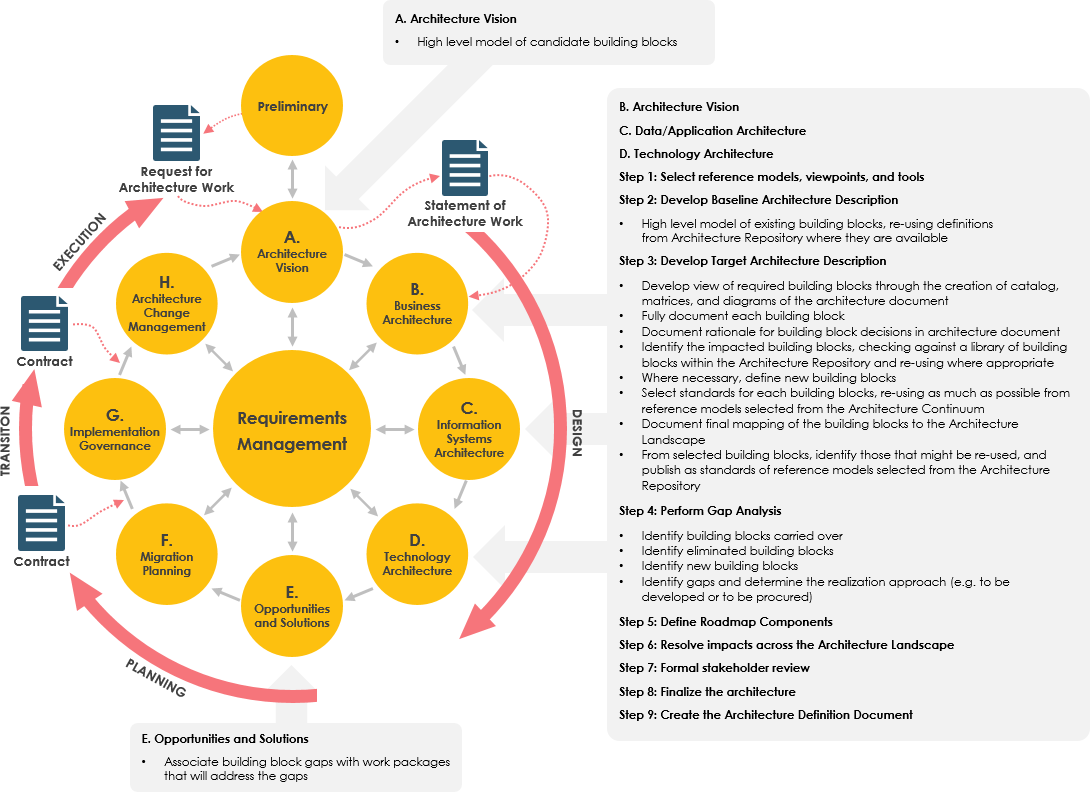
Today, modern tools—particularly those leveraging Artificial Intelligence (AI)—have evolved this concept from a static template into an intelligent co-pilot. This evolution allows organizations to shift from being “scribes” of architecture to “conductors,” focusing on high-level strategic advice rather than manual documentation.
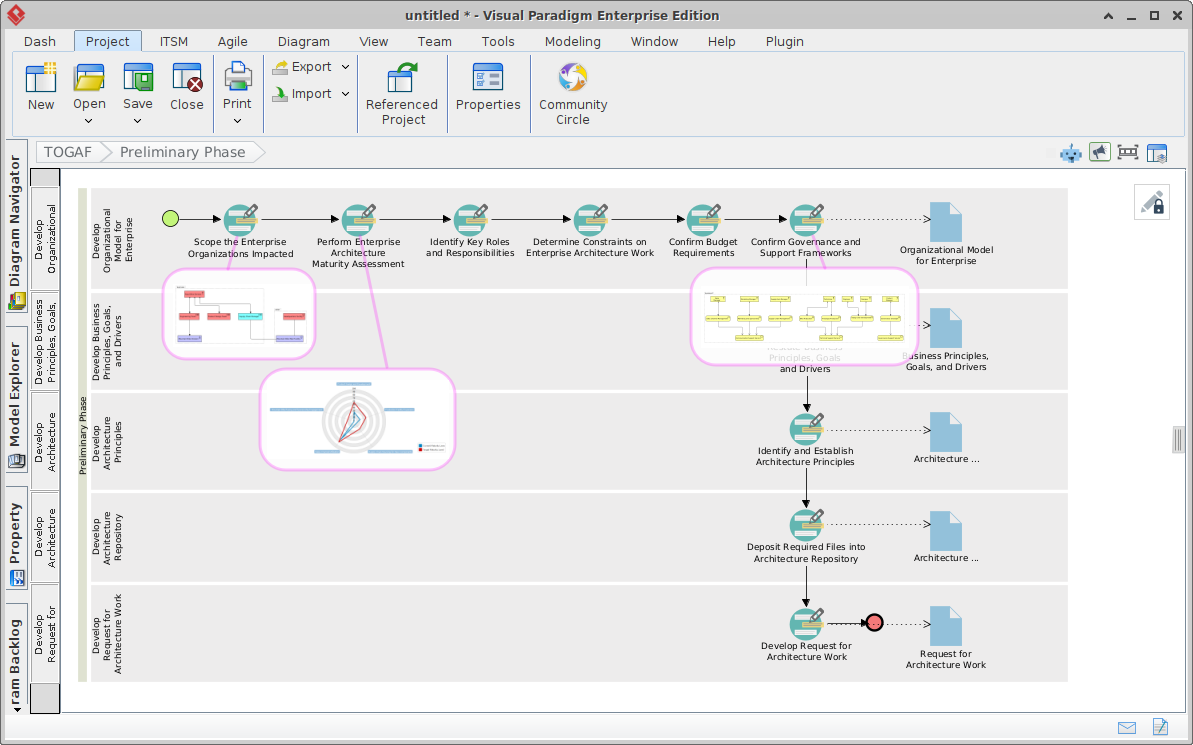
1. Core Components of the Guide-Through Process
The Guide-Through methodology breaks the 10-phase ADM cycle into an interactive workflow. Key features typically included in these solutions are:
1.1 The Process Navigator
-
Visual Roadmap: Often represented as a “crop circle” diagram or interactive flowchart, this allows users to visualize the entire ADM cycle at a glance.
-
Progress Tracking: Users can click through phases sequentially, overriding defaults when necessary to tailor the roadmap to specific corporate strategies while maintaining structural integrity.
1.2 Actionable Activities
Instead of high-level theory, each phase is decomposed into specific, actionable steps. Common activities include:
-
Phase A (Vision): Defining stakeholders and developing a Scope Statement.
-
Phase B (Business): Mapping business processes and identifying capability gaps.
-
Phase C (Information): Analyzing data models and taxonomies.
-
Phase H (Implementation): Creating Work breakdown structures (WBS) and detailed implementation plans.
1.3 Deliverable Composer
This feature acts as an intelligent document generator. As architects input data and make decisions during the guide-through activities, the system automatically:
-
Generates professional ArchiMate models (diagrams).
-
Creates Architectural Catalogs and matrices.
-
Produces Stories and gap analysis reports.
-
Ensures that artifacts are consistent with the underlying data, not just formatted templates.
1.4 Built-in Guidance
Unlike traditional ADM where knowledge resides solely in the architect’s head, the Guide-Through provides:
-
Step-by-step Instructions: Clear guidance on what to do at every node.
-
Real-world Samples: Pre-populated examples of how experienced architects handle specific scenarios.
-
Case Studies: Contextual examples drawn from various industries to demonstrate best practices.
2. Streamlining with AI-Powered Features
Modern implementations of the Guide-Through process, such as those by Visual Paradigm, integrate AI to accelerate the ADM lifecycle. This AI acts as an intelligent collaborator, reducing the manual effort typically associated with Enterprise Architecture (EA).
2.1 Natural Language Interpretation
Architects can describe high-level requirements in plain English. The AI parses this input and instantaneously transforms it into complex ArchiMate models, populating specific model elements based on the context of the description.
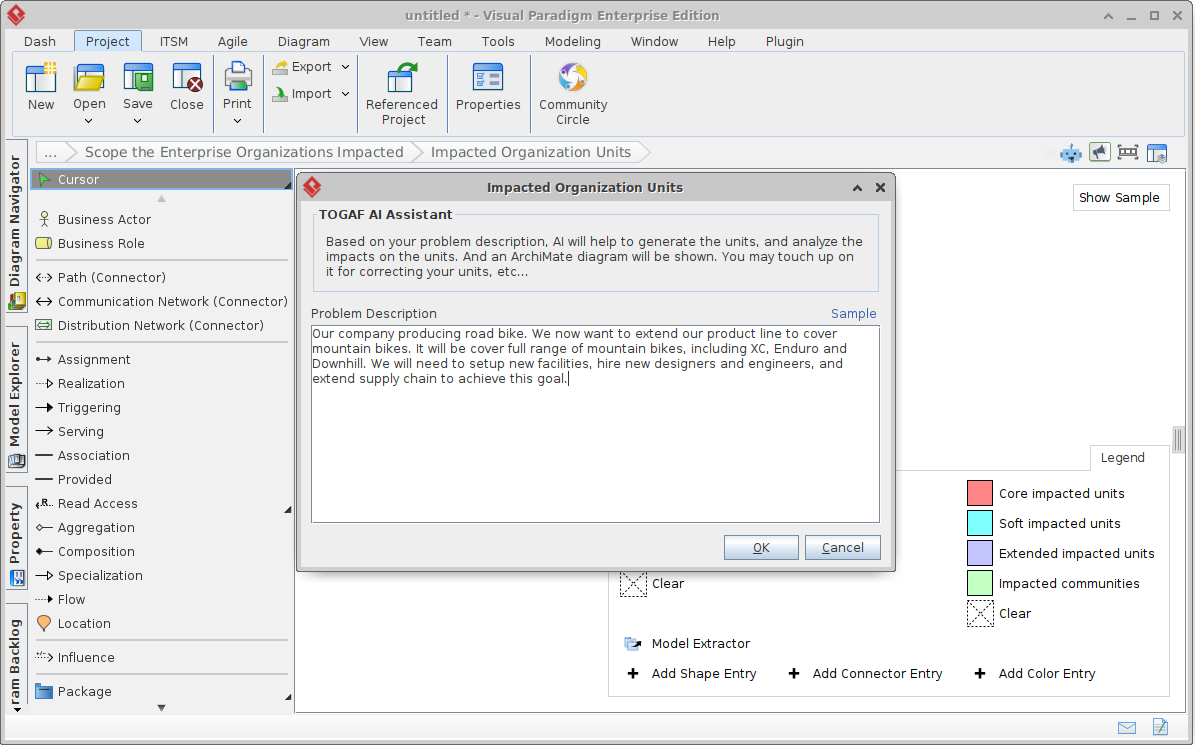
2.2 Automated Artifact Generation
Manual diagramming is one of the most time-consuming aspects of EA. AI tools can reduce this effort by 70%–80% by:
-
Automatically building Radar charts based on input scores.
-
Generating GAP models by comparing baseline and target states.
-
Creating Work Breakdown Structures (WBS) hierarchies for implementation planning.
2.3 Intelligent Gap Analysis
Rather than manually comparing two static models, AI can analyze the baseline state (Current Architecture) and the target state (Future Architecture) to:
-
Identify specific technology and capability gaps.
-
Suggest tailored migration roadmaps to close these gaps efficiently.
2.4 Automated Maturity Assessments
AI can assess the current maturity of business and IT capabilities. It accepts natural language input regarding organizational capabilities and automatically renders professional Radar Charts (as required in the Preliminary Phase and throughout the cycle) to visualize strengths and weaknesses.
2.5 Smart Consistency Checks
A significant challenge in ADM is maintaining consistency as the process moves from Phase A through Phase H. AI continuously verifies that:
-
Inputs from Phase A (Architecture Vision) are correctly propagated to Phase B, C, etc.
-
Changes in later phases do not contradict early decisions, ensuring a cohesive architectural narrative.
2.6 Expert-Level Guidance
For junior architects or those new to TOGAF, the AI acts as a mentor. It provides:
-
Context-aware suggestions for artifact design.
-
Prompts to ensure no critical steps are missed.
-
Real-time feedback to lower the skill barrier required for producing high-quality EA work.
3. Practical Example: AI in Phase A and Impact Analysis
Imagine an organization initiating a Digital Transformation project.
Traditional Approach:
-
Manually create a scoring sheet for stakeholders.
-
Manually draw a Radar Chart for the Preliminary Phase.
-
Spend days defining the Architecture Vision scope.
-
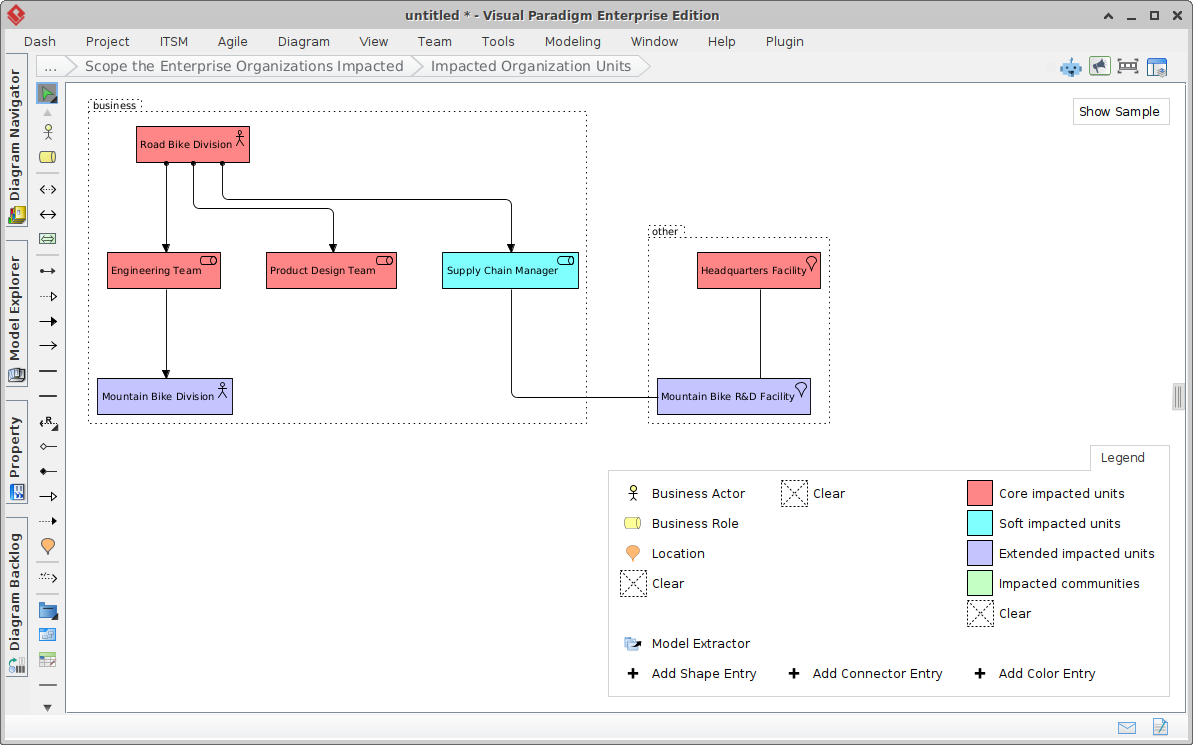
Manually map out the impact analysis table.
AI-Enhanced Guide-Through Approach:
-
Input: The architect types: “We are launching a cloud migration project aiming for 40% cost reduction, 60% speed increase, and 80% security compliance within 18 months.”
-
Process:
-
AI Action 1 (Vision): Converts this text into a structured Architecture Vision Statement and populates the stakeholder criteria.
-
AI Action 2 (Maturity): Automatically generates a Radar Chart for the Preliminary Phase, scoring the current state versus the target state described in the text.
-
AI Action 3 (Impact): Creates the Impact Analysis table, highlighting departments affected by the shift to the cloud and the required capability upgrades.
-
-
Result: The architect spends less time documenting format and more time refining the strategic strategy.
4. Strategic Benefits
By adopting the TOGAF Guide-Through Process with AI integration, organizations achieve:
-
Increased Efficiency: Drastic reduction in the time spent on documentation and modeling.
-
Consistency: Fewer errors due to automated consistency checks across all ADM phases.
-
Scalability: Ability to perform comprehensive EA assessments on larger, more complex portfolios without linearly increasing headcount.
-
Accessibility: Lowering the barrier to entry, allowing junior architects to perform expert-level work with AI mentorship.
Conclusion
The TOGAF ADM Guide-Through Process represents the maturation of Enterprise Architecture methodology. By combining the rigorous structure of the 10-phase ADM with modern AI capabilities, organizations can navigate the complexity of architectural transformation with greater agility, precision, and strategic focus. The future of EA is not about having the most knowledgeable scribes, but about empowering conductors who use AI to orchestrate complex architectural landscapes.
References
- Visual Paradigm: TOGAF ADM Guide-Through Tutorial: A comprehensive tutorial covering the step-by-step execution of the TOGAF ADM, explaining how the process transforms abstract frameworks into manageable activities and deliverables.
- Visual Paradigm: Solution TOGAF Guide-Through Process: An overview of the Visual Paradigm solution offering a process navigator, actionable activities, and deliverable generation to simplify the ADM cycle.
- Visual Paradigm: AI-Powered TOGAF ADM Tool Features: Details the AI features of the tool, including natural language interpretation, automated artifact generation, intelligent gap analysis, and expert-level guidance to act as an intelligent co-pilot.
- Circle: How to Use the TOGAF ADM Guide-Through: A user guide explaining how to interact with the tool, covering the use of the crop circle diagram, entering data, and generating artifacts.
- Visual Paradigm: TOGAF ADM Tool for Enterprise Architecture: Tutorials and information regarding the specific capabilities of the Visual Paradigm TOGAF ADM tool for performing detailed enterprise architecture work.
- The Knowledge Academy: TOGAF ADM Phases: An educational resource detailing the standard phases of the Architecture Development Method and their respective goals.
- Archimetric: Comprehensive TOGAF ADM Tool Evaluation Guide: An evaluation guide comparing various tools that support the TOGAF framework and guide-through processes.
- Archimetric: Comprehensive Guide to Visual Paradigm’s TOGAF ADM Guide-Through Process: A detailed look at the features and benefits of visual paradigms’ specific implementation of the TOGAF Guide-Through process.
- Visual Paradigm Updates: AI Powered TOGAF Guide-Through Release: Official release notes describing the introduction of new Artificial Intelligence capabilities into the TOGAF Guide-Through process.
- Archimetric: AI Powered TOGAF Guide-Through: Analysis of how AI technologies are being integrated into TOGAF tools to automate artifacts and improve consistency in the ADM lifecycle.
Related posts:
 Visual Paradigm ArchiMate Modeling & AI Integration: A Comprehensive Feature Review Guide
 Mastering Enterprise Architecture with Visual Paradigm: A User’s Journey to AI-Driven ArchiMate Modeling
 🚀 Complete Guide: Send Your Visual Paradigm Online Creations Directly to OpenDocs
 My Hands-On Review: Creating Professional UML Diagrams with Visual Paradigm Online