
Architecting Future Documentation with Visual Paradigm OpenDocs
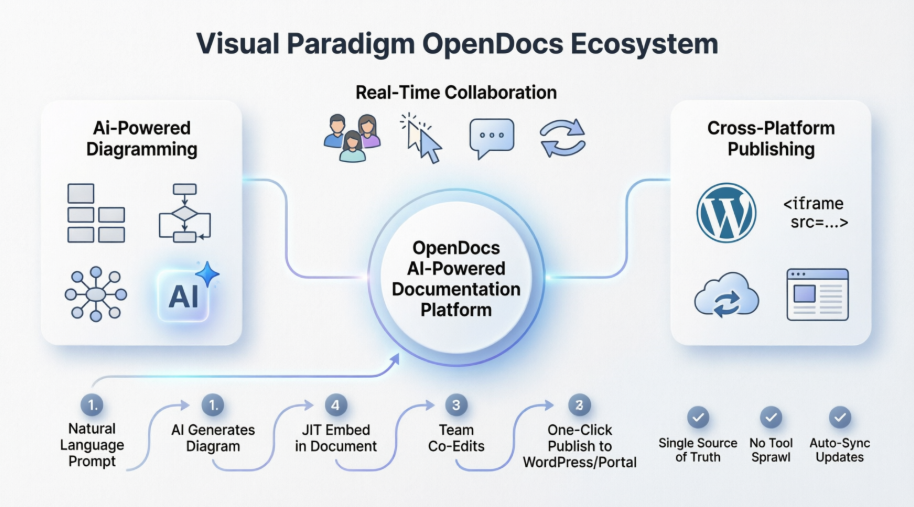
In the rapidly evolving landscape of enterprise technology, documentation often becomes a bottleneck. While development teams rush to ship code, the documentation required to support it frequently suffers from version drift, tool fragmentation, and a lack of visual context. Visual Paradigm OpenDocs addresses this critical gap by converging professional-grade visual modeling, generative AI, and real-time collaboration into a unified platform. This tutorial explores the ecosystem architecture depicted in the OpenDocs diagram, breaking down how it transforms the documentation lifecycle from a fragmented manual process into an intelligent, automated workflow.
The Central Hub: An AI-Powered Platform
At the heart of the ecosystem is the OpenDocs AI-Powered Documentation Platform. Unlike traditional documentation tools that rely on static text or isolated diagram editors, OpenDocs acts as a central orchestration layer. It is designed to maintain a “Single Source of Truth,” ensuring that the visual models (like UML or BPMN) are not just pictures, but executable or linked data that drives the content.
This central hub connects three distinct pillars of modern technical communication:
- AI-Powered Diagramming: Transforming abstract ideas into structured visual models instantly.
- Real-Time Collaboration: Enabling distributed teams to edit and refine artifacts simultaneously.
- Cross-Platform Publishing: Seamlessly distributing knowledge to external portals, wikis, or codebases.
Step 1: The Ingestion Engine (Natural Language to Model)
The journey begins on the left side of the ecosystem with AI-Powered Diagramming. The diagram highlights a workflow starting with a “Natural Language Prompt.” In the OpenDocs architecture, this is the entry point for knowledge creation.
- Prompting: A user inputs a request in plain English (e.g., “Create a sequence diagram for a user login flow”).
- AI Generation: The generative AI engine parses the intent and syntax requirements, automatically generating a professional-grade diagram (UML, ER, BPMN, etc.).
- Validation: The generated model is structurally sound, ready for immediate review or further refinement.
This capability drastically reduces the “Time-to-Clarity.” Instead of spending hours configuring tool palettes, teams can focus on the logic of the system itself.
Step 2: The Collaboration Loop (JIT Embed & Co-Edit)
Once the model exists, the workflow moves into the collaborative phase. The diagram illustrates a seamless loop involving JIT (Just-In-Time) Embedding and Team Co-Editing.
In traditional setups, a diagram is often an image file (PNG/JPG) pasted into a document. If the diagram changes, the image must be manually updated. OpenDocs changes this paradigm:
- JIT Embed in Document: Diagrams are embedded directly into the documentation text as live objects. This is not a static snapshot; it is a live reference.
- Team Co-Edits: Multiple stakeholders (Architects, Developers, Writers) can access the same document simultaneously. Changes made to the diagram are instantly reflected in the text, and vice versa.
This ensures that the “living” documentation remains synchronized. If a developer updates the architecture diagram, the documentation does not become stale; it updates in real-time.
Step 3: The Distribution Layer (Cross-Platform Publishing)
The final stage of the architecture is Cross-Platform Publishing. The diagram explicitly highlights integration with platforms like WordPress via <iframe> tags and cloud synchronization. This is the “publish” phase where the value of the documentation is realized.
The OpenDocs engine supports:
- One-Click Publish: Pushing content to external destinations (Portals, Wikis) without manual export/import steps.
- Auto-Sync Updates: If the source diagram in OpenDocs is updated, the published version on WordPress or other portals updates automatically.
- Tool Sprawl Reduction: You no longer need a separate tool for the diagram, a separate tool for the text, and a separate tool for the website.
Summary of the Ecosystem Benefits
The Visual Paradigm OpenDocs ecosystem solves the “Fragmented Workflow” problem by unifying the lifecycle:
- Speed: AI generation cuts design time from hours to seconds.
- Accuracy: JIT embedding eliminates the risk of broken links or outdated images.
- Scalability: One-click publishing allows a single document to serve as a source of truth for internal wikis, external help centers, and developer portals.
By adopting this architecture, organizations move away from static, error-prone documentation and toward a dynamic, AI-driven knowledge management system.