
From Idea to Architecture: Mastering the VP AI Ecosystem Workflow
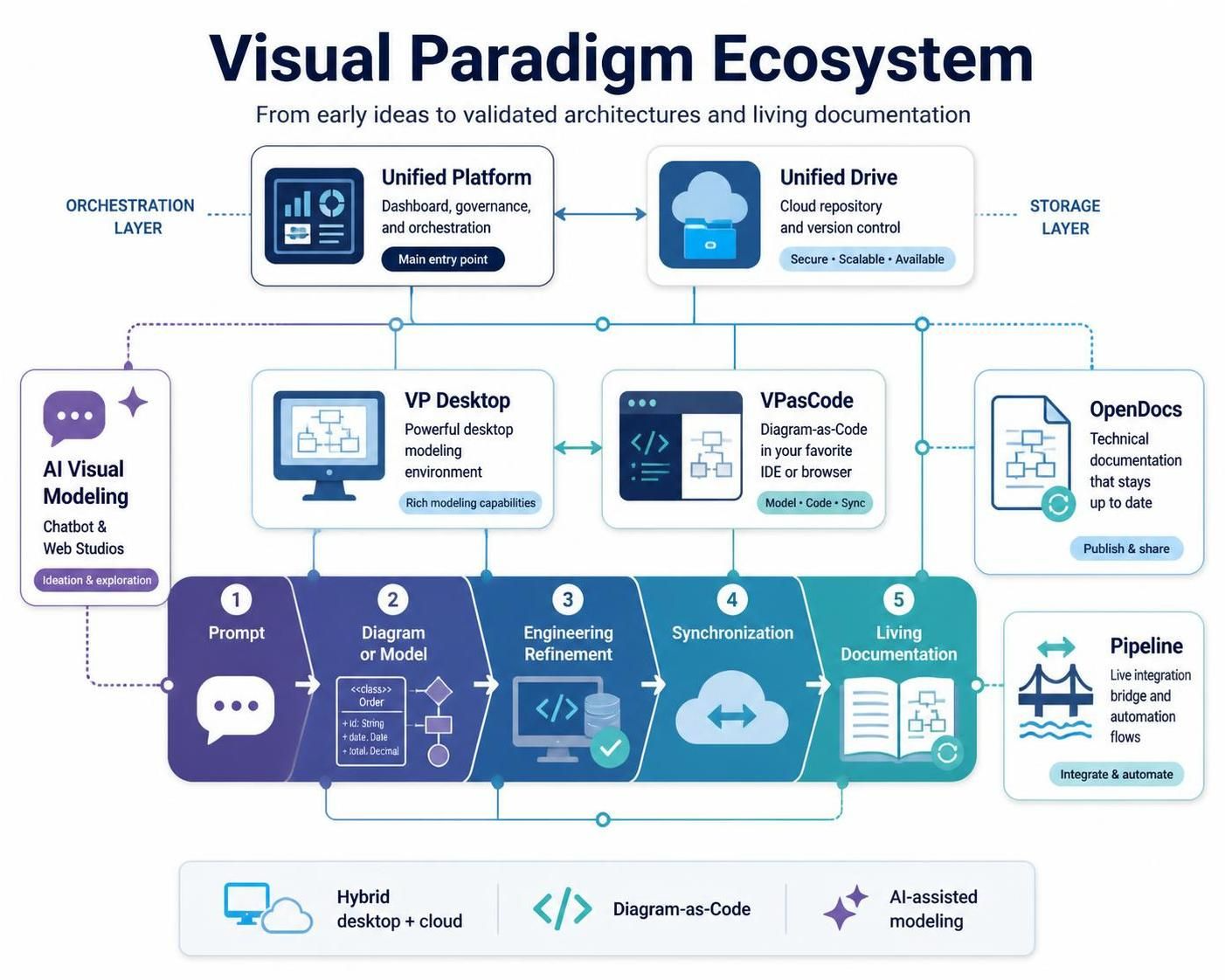
In modern software engineering, the gap between a high-level idea and a validated, documented architecture can often lead to information loss and version control nightmares. Visual Paradigm addresses this by creating a unified ecosystem that bridges the divide between traditional desktop modeling and modern text-driven workflows. This tutorial explores how this architecture supports the full lifecycle of software development, from the initial prompt to living documentation.
1. The Core Architecture: Orchestrating Tools
The Visual Paradigm ecosystem is not a collection of isolated tools; it is an integrated environment organized around a centralized Orchestration Layer. This layer ensures that data flows seamlessly between different modes of working.
The Foundation: Unified Platform and Drive
Everything begins with the Unified Platform, which serves as the dashboard for governance and access. Connected directly to this is the Unified Drive, a cloud repository that acts as the single source of truth. This storage layer ensures that your artifacts are secure, scalable, and available across different access points.
The Modeling Engines
Depending on your workflow preference, you can utilize two primary modeling engines:
- VP Desktop: The powerful local application designed for detailed enterprise modeling. It offers rich capabilities for complex engineering tasks.
- VPasCode: A browser-based platform for “Diagram-as-Code.” This allows developers to create architecture using text in their favorite IDE, leveraging version control for robust architecture management.
The AI and Documentation Layer
To accelerate the process, the ecosystem integrates AI Visual Modeling (Chatbot & Web Studios) to turn natural language into diagrams. Furthermore, OpenDocs provides a dedicated environment for technical specifications, ensuring that documentation stays synchronized with your models.
2. The Lifecycle: From Prompt to Living Documentation
The true power of this ecosystem lies in its linear yet flexible workflow. The process follows five distinct stages, transforming abstract thoughts into concrete, automated artifacts.
- Prompt: The journey begins with ideation. Using AI tools, you can input a natural language description of your system requirements.
- Diagram or Model: The system translates the prompt into a structured model or diagram. This can be generated automatically or manually refined in VP Desktop.
- Engineering Refinement: This is where the work happens. You can move from a rough sketch to a detailed, executable specification. Whether using the visual interface or code, you validate the logic and structure here.
- Synchronization: Once the model is refined, the system automatically syncs the changes to the Unified Drive. This step ensures that the “source of truth” is always up to date without manual file exports.
- Living Documentation: The final stage is the output. Using the Pipeline, the system integrates with documentation tools (OpenDocs) to generate technical specifications that update automatically as the model changes.
3. Deep Dive: The VPasCode Workflow
For developers who prefer a text-based approach, the VPasCode component is revolutionary. It allows you to write diagrams as code, which can be version-controlled in Git and integrated into CI/CD pipelines. This approach eliminates the “spaghetti diagram” problem by forcing a structured, logical definition of your architecture.
Below is an example of how a simple class structure might be defined in VPasCode to demonstrate the syntax:
class Order {
    +id: String
    +date: Date
    +total: Decimal
}

class Customer {
    +customerId: String
    +name: String
}

Customer "1" -- "0..*" Order
In this workflow, the code is not just a representation; it is the executable definition. When you run the synchronization step, this text is rendered into the visual model, and vice versa.
Conclusion
By unifying desktop and cloud capabilities, Visual Paradigm eliminates the friction between modeling and documentation. Whether you start with a chatbot prompt or a line of code, the ecosystem ensures that your architectural intent is preserved, validated, and documented throughout the entire development lifecycle.