
Mastering the 4-Phase VP AI Ecosystem Workflow: From Ideas to Knowledge
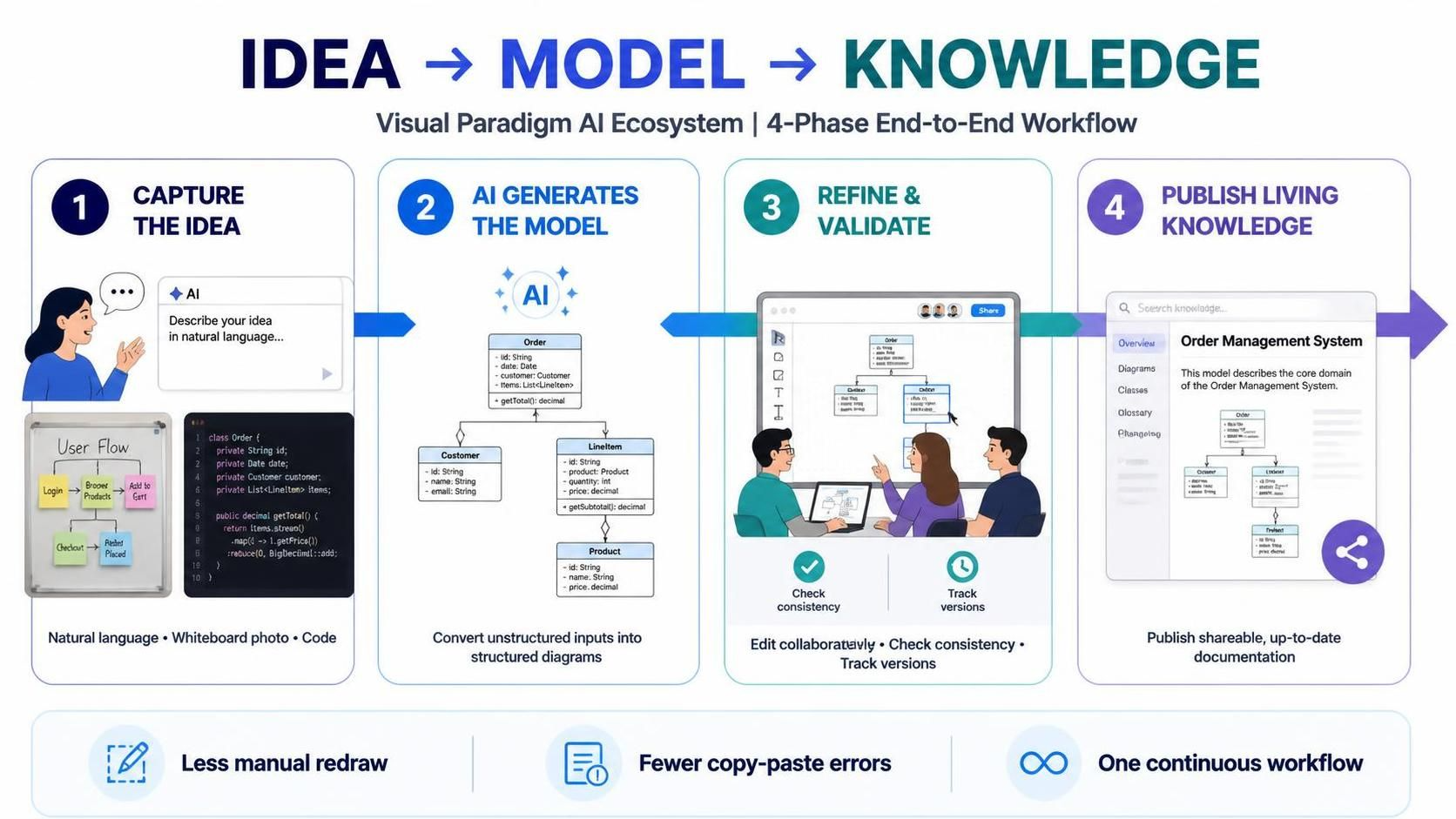
In modern software engineering and product management, the transition from a fleeting thought to a formalized, shareable diagram is often where momentum is lost. Traditional workflows force teams to manually redraw sketches, struggle with version control across disjointed tools, and introduce inconsistencies into critical documentation. The Visual Paradigm AI Ecosystem addresses these challenges by introducing a seamless, continuous pipeline.
This tutorial explores the recommended 4-Phase End-to-End Workflow, demonstrating how teams can move from initial ideation to published knowledge bases without breaking their creative flow.
Phase 1: Capture the Idea
The workflow begins in the natural environment where ideas are born. Historically, teams had to choose between a quick whiteboard sketch (which is hard to share) or a formal tool (which is slow to start). This phase eliminates that trade-off by supporting unstructured inputs.
Input Sources:
- Natural Language: Simply describe your system architecture or user flow in plain text. For example, “Create a user flow for an e-commerce login process.”
- Whiteboard Photos: Snap a photo of a brainstorming session. The AI interprets the hand-drawn nodes and connectors.
- Code Snippets: Paste raw code (e.g., Java or C# classes). The AI can reverse-engineer these snippets into Class Diagrams or Sequence Diagrams automatically.
Phase 2: AI Generates the Model
Once the unstructured input is ingested, the Visual Paradigm AI Engine acts as the bridge between chaos and order. It transforms the raw data into structured, enterprise-grade models.
The Transformation Process:
- Semantic Analysis: The AI parses the text or image to identify entities (e.g., “Customer”, “Order”) and relationships.
- Structure Mapping: It maps these entities to specific diagram types. A description of data storage becomes a Data Model; a description of user steps becomes a User Flow.
- Diagram Rendering: The system generates the visual representation instantly, complete with proper styling and layout algorithms.
Phase 3: Refine & Validate
Generation is only the first step. This phase focuses on human-in-the-loop collaboration to ensure accuracy and consistency.
Key Capabilities:
- Collaborative Editing: Multiple stakeholders can view and edit the model simultaneously, ensuring that the technical details match the business requirements.
- Consistency Checks: The system can validate the model against defined rules, ensuring that relationships (e.g., foreign keys or dependencies) are logically sound.
- Version Tracking: Unlike static images, these models maintain a history of changes, allowing teams to track the evolution of the design over time.
Phase 4: Publish Living Knowledge
The final phase transforms the diagram from a static drawing into a dynamic, searchable asset. The goal is to create a “Living Documentation” system.
Outcome:
The models are published to a Knowledge Base where they become searchable and context-aware. Instead of a dead image in a Word document, the diagram becomes an interactive reference point. Users can search for “Order Management” and find the relevant diagram, its associated classes, and the underlying logic.
Technical Implementation: Generating the Model
While the AI handles much of the heavy lifting, understanding the underlying code generation logic is crucial for advanced users. In Visual Paradigm, you can often trigger these workflows via code or specific syntax definitions. Below is an example of how a class structure is defined programmatically, which the AI can then render into the Phase 2 diagram.
public class Order {
    private String id;
    private Date date;
    private Customer customer;
    private List<LineItem> items;

    // Getter and Setter methods
    public String getId() {
        return id;
    }

    public void setId(String id) {
        this.id = id;
    }

    // Business Logic
    public decimal getTotal() {
        return items.stream()
            .mapToDouble(LineItem::getTotal)
            .sum();
    }
}

public class Customer {
    private String name;
    private String email;
    // ...
}
Conclusion
The shift from manual drawing to AI-assisted modeling represents a fundamental change in how engineering teams operate. By leveraging the 4-Phase Workflow, organizations achieve:
- Less Manual Redraw: Focus on the “What” and “Why,” not the “How to draw it.”
- Fewer Copy-Paste Errors: Automated generation ensures data integrity.
- One Continuous Workflow: Seamless movement from idea to knowledge base.
Whether you are a developer documenting a new API or a product manager sketching a new feature, this ecosystem provides the infrastructure to scale your thinking.