
Mastering BPMN 2.0 Modeling: How Visual Paradigm Leverages AI and Simulation for Enterprise Agility
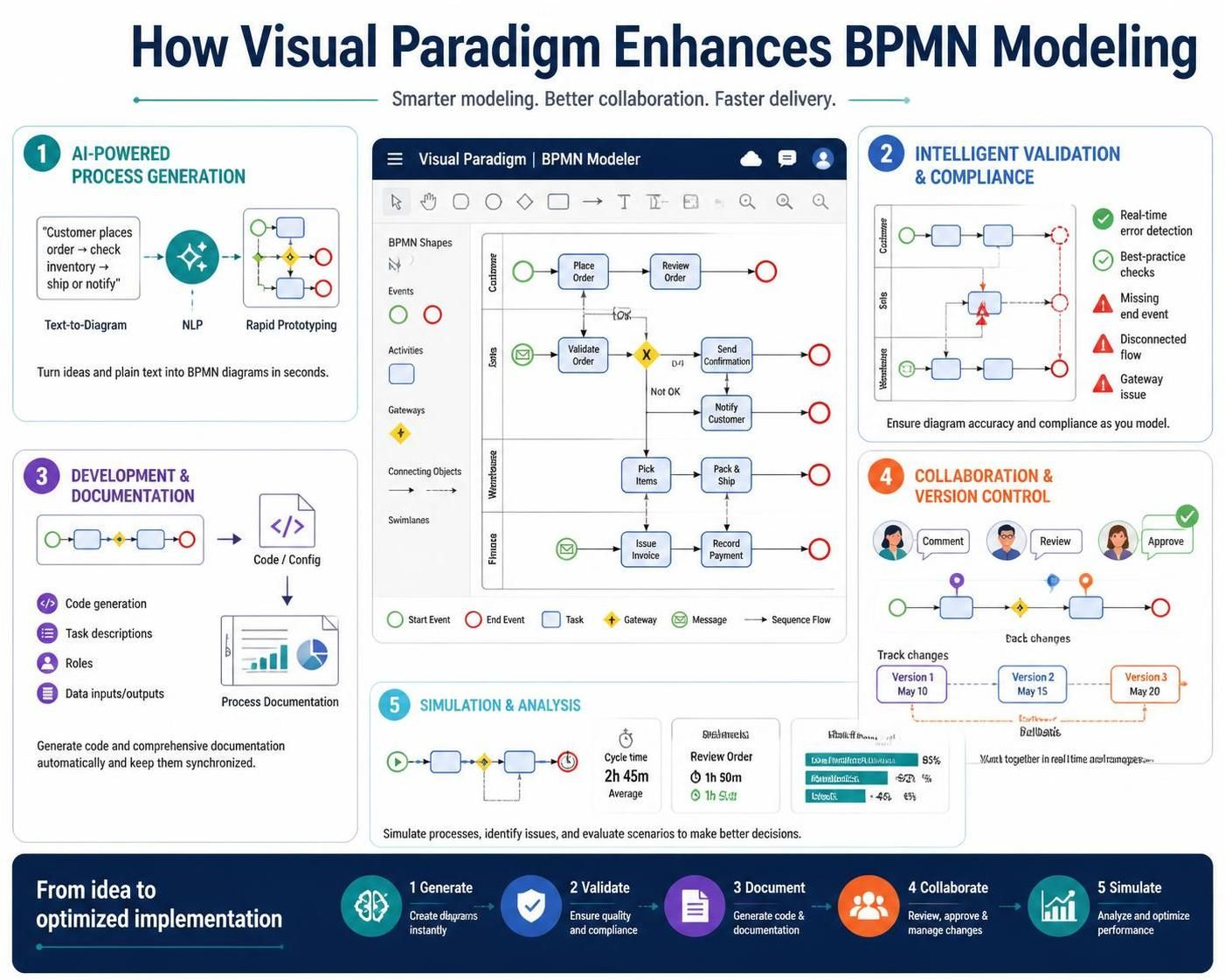
In the realm of Business Process Management (BPM), the gap between business requirements and technical implementation often leads to project delays and misalignment. BPMN (Business Process Model and Notation) 2.0 serves as the universal language to bridge this divide, but mastering its syntax and semantics can be a steep learning curve. This tutorial explores how modern tools like Visual Paradigm are revolutionizing the modeling landscape by integrating Artificial Intelligence, real-time validation, and simulation capabilities.
1. The Paradigm Shift: From Manual Drafting to AI-Driven Generation
Traditionally, creating a BPMN diagram required selecting shapes from a palette and manually connecting them. This was time-consuming and prone to human error. Visual Paradigm introduces a paradigm shift through its AI-Powered Process Generation features.
Text-to-Diagram Architecture
The core of this innovation is the integration of Natural Language Processing (NLP). Instead of a blank canvas, the analyst provides a textual description of the business logic. The system parses this input to identify entities (actors), events (start/end), and decision points (gateways).
Scenario: Online Order Processing
Imagine a scenario where a customer places an order. The logic dictates checking inventory availability. If the item is in stock, it ships; otherwise, a notification is sent.
Here is how this logic is translated from natural language into structured modeling code:
@startuml
title Customer Order Process
autonumber

start
:Customer Places Order;
if (Inventory Available?) then (Yes)
  :Pick Items;
  :Pack and Ship;
  :Send Confirmation;
  stop
else (No)
  :Notify Customer;
  stop
endif
@enduml
Visual Paradigm’s AI engine interprets this logic, automatically placing the correct BPMN 2.0 elements (Start Event, Exclusive Gateway, Task, End Event) and connecting them with Sequence Flows. This allows for rapid prototyping during brainstorming sessions.
2. Ensuring Integrity: Intelligent Validation & Compliance
One of the most significant challenges in BPMN is ensuring syntactical correctness. A common mistake is creating a “dead end” where a flow has no exit, or using an incorrect Gateway type that causes a deadlock.
Real-Time Error Detection
Visual Paradigm acts as a vigilant guardian, performing Real-Time Validation as you model. It checks against the strict BPMN 2.0 specification to prevent logical errors before they become part of the project documentation.
- Missing End Events: The system flags any process flow that terminates without an End Event marker.
- Disconnected Flows: It ensures every Gateway and Task is properly connected, preventing “orphaned” logic.
- Best Practice Checks: It suggests improvements based on industry standards, ensuring diagrams are not only valid but also readable and standardized.
3. The Digital Thread: Integration with Development
Once a process is modeled, the journey doesn’t stop at documentation. The “Digital Thread” connects the visual model to the technical implementation, ensuring that the code matches the design.
Code & Configuration Generation
Visual Paradigm bridges the gap between business analysts and developers. It supports the generation of skeleton code and configuration files directly from the BPMN diagram. This is crucial for workflow engines that execute the business logic.
Key Integration Features:
- Code Generation: Automatically creates Java, C#, or XML configurations based on the tasks and roles defined in the model.
- Documentation Automation: The platform can generate comprehensive process documentation. It automatically extracts descriptions, role responsibilities, and data inputs/outputs, ensuring the documentation stays synchronized with the visual model.
4. The Future of Process Management: Simulation & Analysis
Static diagrams tell us what the process should look like, but they don’t tell us how it will perform under load. Visual Paradigm’s Simulation & Analysis module turns the model into a dynamic testing ground.
Process Simulation Mechanics
Users can simulate process execution to identify bottlenecks and calculate cycle times. By assigning parameters such as “Processing Time” and “Resource Availability,” the system can run thousands of iterations to predict real-world performance.
What-If Analysis:
Before implementing a change in the real world, you can test scenarios. For example: “What if we add another approver to the invoice process?” The simulation will instantly recalculate the cycle time, showing whether the change improves efficiency or introduces new delays.
Conclusion
By leveraging tools like Visual Paradigm, organizations move beyond simple diagramming to intelligent process management. The combination of AI-assisted generation, strict compliance validation, and proactive simulation ensures that BPMN models are accurate, actionable, and perfectly aligned with business goals.