
Mastering BPMN: How to Model Reusable Processes Consistently with Governance
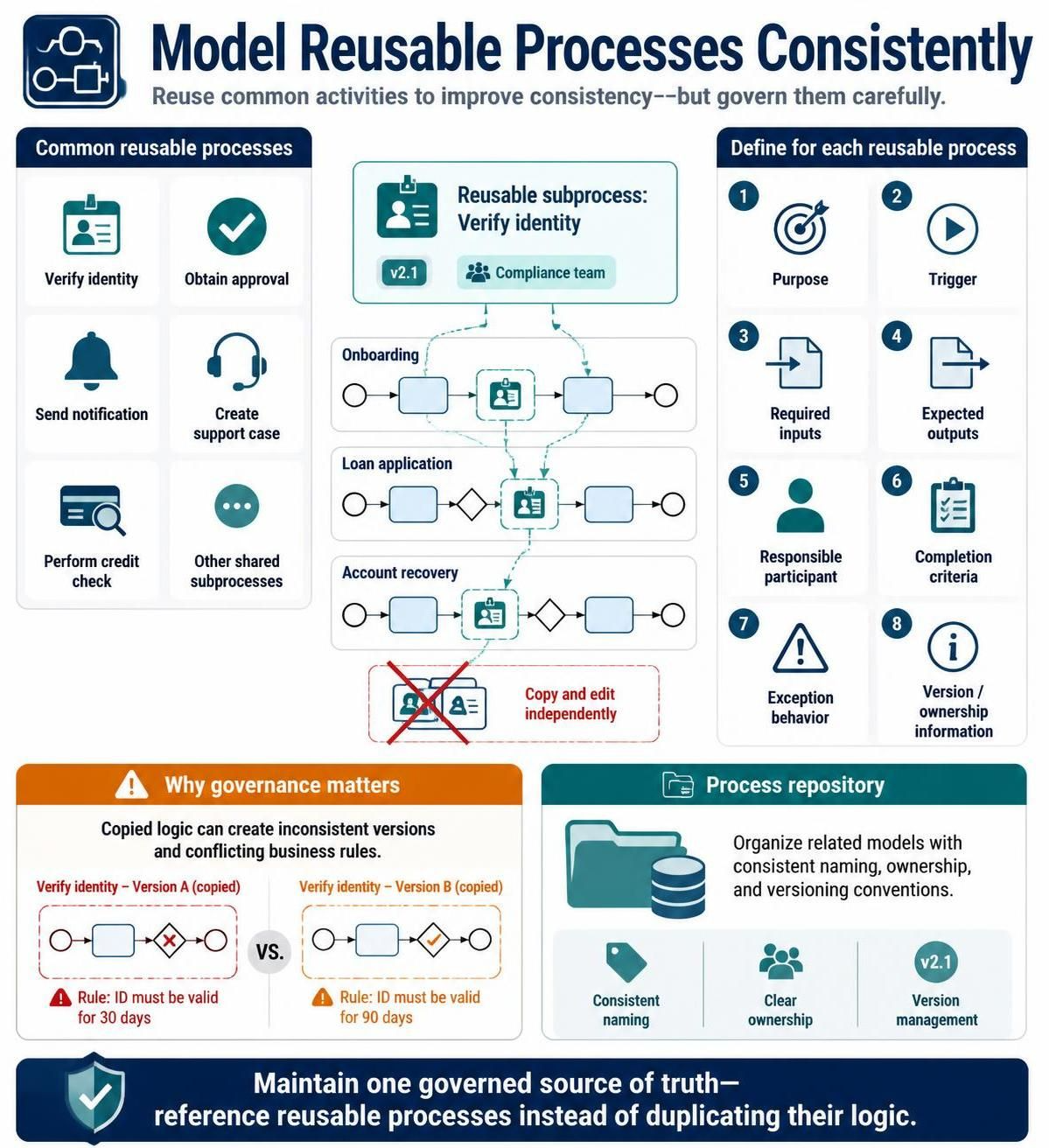
In the world of Business Process Management (BPM), efficiency is paramount. One of the most effective ways to streamline operations is to identify common activities and turn them into reusable subprocesses. However, as illustrated by the “Model Reusable Processes Consistently” diagram, this practice requires a disciplined approach. Without proper governance, reusing logic can lead to fragmented data, conflicting business rules, and maintenance nightmares.
This tutorial walks you through the architecture of reusable processes, the specific governance attributes required to manage them, and the critical risks of independent editing.
The Architecture of a Reusable Subprocess
At its core, a reusable process is a modular block of logic that can be inserted into multiple parent workflows. Consider the “Verify Identity” subprocess shown in the central diagram. This logic is not unique to one specific workflow; it is a fundamental requirement shared across different business scenarios.
Visual Paradigm allows you to model this relationship effectively:
- The Master Definition: This is the “Source of Truth.” It is the standalone diagram where the detailed logic of the subprocess (e.g., the specific steps to verify identity) is defined.
- The Reference Points: These are the parent processes (like “Onboarding,” “Loan Application,” or “Account Recovery”) that call upon the master definition.
By linking these diagrams, you ensure that the “Verify Identity” logic remains identical across all three scenarios. If the identity verification rules change, you update the master definition once, and the change propagates to all parent processes.
The 8 Pillars of Governance
Simply creating a subprocess is not enough. The diagram emphasizes that for a process to be truly reusable and maintainable, it must be strictly governed. The infographic outlines eight critical attributes that must be defined for every reusable process.
1. Purpose and Trigger
Every subprocess needs a clear Purpose—a concise statement of what it achieves (e.g., “Authenticate user credentials”). It also requires a defined Trigger, which dictates exactly when the process initiates. Is it triggered by a form submission? A time-based event? Or an API call?
2. Data Flow (Inputs & Outputs)
To ensure interoperability, you must define:
- Required Inputs: What data does the subprocess need to start? (e.g., a user ID, an ID card image).
- Expected Outputs: What data does it return upon completion? (e.g., a boolean “True/False” for validity, or a verified user token).
3. Ownership and Roles
Who is responsible for this process? The diagram highlights the Responsible Participant. In the example, the “Compliance Team” is responsible for identity verification. Clearly assigning ownership ensures that the right stakeholders are consulted when the process needs to be modified.
4. Success and Failure States
A robust process must define:
- Completion Criteria: What specific conditions must be met to mark the process as “Done”?
- Exception Behavior: What happens if things go wrong? (e.g., “If ID is invalid, route to manual review queue”).
5. Versioning and Metadata
Just like software code, processes evolve. The diagram explicitly calls for Version or Ownership Information (e.g., v2.1). This allows teams to track the history of the process, roll back to previous versions if necessary, and understand the current state of the logic.
The Danger of Independent Copying
The infographic contains a stern warning: “Avoid copying and independently editing the same logic.” This is the most common pitfall in process modeling.
Imagine a scenario where a modeler “copies” the “Verify Identity” subprocess and pastes it directly into a new diagram rather than linking to the master process. If they edit this copy to change a rule (e.g., “ID must be valid for 30 days”), but leave the original “Onboarding” process with a different rule (e.g., “ID must be valid for 90 days”), you have created a Version Conflict.
Scenario: Conflicting Business Rules
As shown in the “Why governance matters” section of the diagram, independent editing leads to:
- Process A (Onboarding): Uses “Verify Identity” with a 30-day rule.
- Process B (Loan Application): Uses a copied “Verify Identity” with a 90-day rule.
This results in inconsistent customer experiences and potential compliance risks. The system effectively has two different definitions of the same business rule.
Implementing a Process Repository
To solve the problem of version drift and inconsistency, the diagram suggests using a Process Repository. In tools like Visual Paradigm, a repository acts as a centralized database for all your models.
By organizing related models in a repository, you enforce strict conventions:
- Consistent Naming: Ensures that “Verify Identity” is always referred to by the same name across all diagrams.
- Clear Ownership: Links every model to a specific owner or department.
- Version Management: Automatically tracks changes and prevents unauthorized overwrites.
Conclusion
Modeling reusable processes is a powerful architectural decision that improves consistency and reduces redundancy. However, it requires a shift from a “copy-paste” mentality to a “reference-and-govern” mentality. By defining clear inputs, outputs, and ownership, and by strictly avoiding independent edits, organizations can maintain a single source of truth for their critical business logic.