
Mastering CRC Cards: UML-Backed Object Design with Visual Paradigm
Class-Responsibility-Collaborator (CRC) modeling is a time-honored technique in software engineering used to design object-oriented systems. Unlike complex UML diagrams that focus on static structure, CRC cards are designed for rapid prototyping and brainstorming. They allow developers to step back from the code and focus on the “what” and “who” of a system before getting bogged down in implementation details.
In modern development environments, this conceptual modeling has evolved. Today, tools like Visual Paradigm allow us to bridge the gap between these abstract cards and concrete documentation pipelines, ensuring your architectural vision never gets lost.
Deconstructing the CRC Card
At its core, a CRC card is a physical or digital index card that represents a class in your system. It forces you to define the class’s role in the system by focusing on three specific pillars:
- Class Name: The identity of the object (e.g.,
Patient,BedManager,Admission). - Responsibilities: The knowledge the class must hold (data) and the services it must perform (methods). This is the “What it does” aspect.
- Collaborators: The other classes this class must communicate with to fulfill its responsibilities. This is the “Who it talks to” aspect.
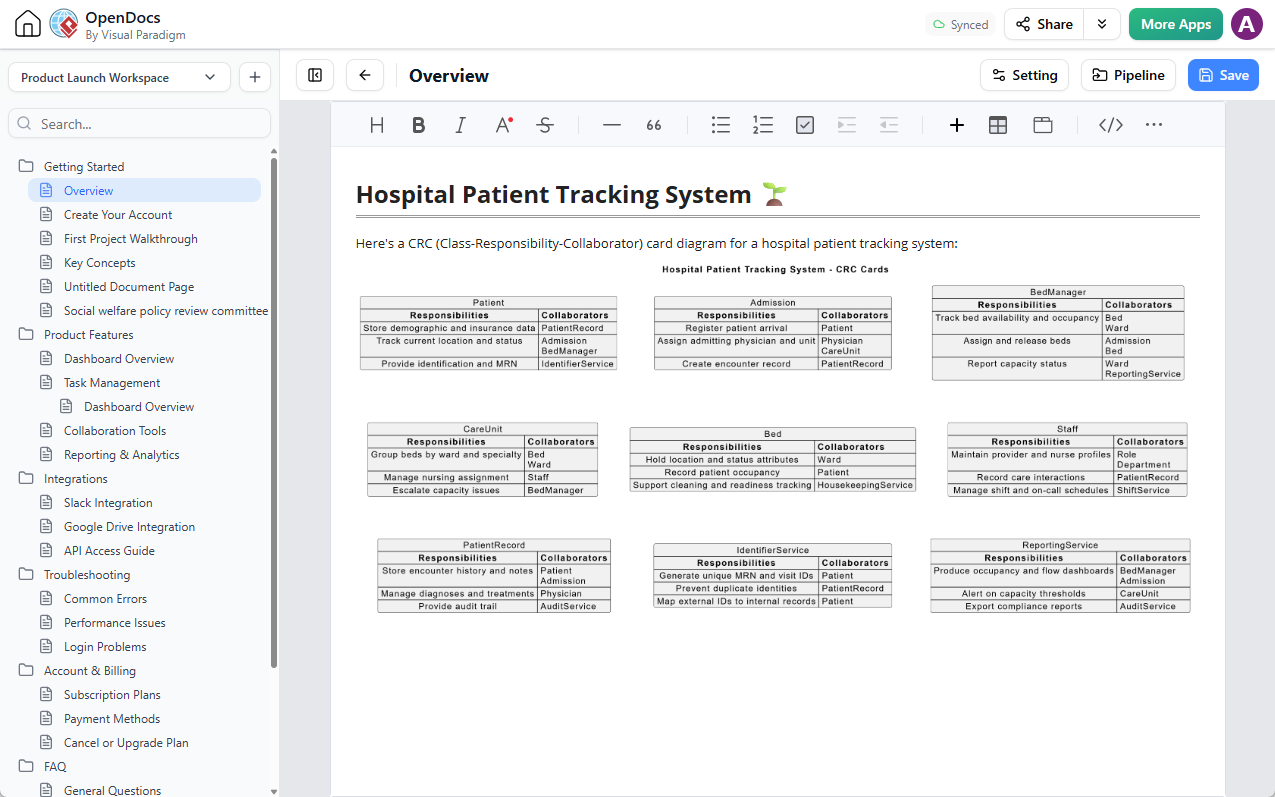
By visualizing these relationships, you can identify missing methods or hidden dependencies early in the design phase. For instance, looking at the BedManager in the diagram above, you see it collaborates with Bed and Ward. This immediately suggests that the BedManager class needs methods to access and modify state within those other classes.
Step-by-Step Modeling Logic
When constructing a system like the Hospital Patient Tracking System shown in the visual reference, follow this logical flow:
- Identify the Domain Entities: Look at the business domain. What are the physical objects? (Bed, Patient, Ward). Create a card for each.
- Assign Responsibilities: Ask “What does a Patient do?” It stores demographic data. What does a
ReportingServicedo? It produces occupancy dashboards. - Trace Collaborations: This is the most critical step. If a
PatientRecordneeds to generate a unique ID, it cannot do it alone. It must collaborate with anIdentifierService. This dependency is then added to the card. - Iterate and Refine: As you add cards, you will often find that a single card is trying to do too much (violating the Single Responsibility Principle). Split the card into two.
The Challenge of Documentation Drift
While CRC cards are excellent for whiteboard sessions, maintaining them in a living system is difficult. In traditional workflows, developers often update the code but forget to update the diagrams. This leads to “documentation drift,” where the architectural specs no longer match the actual codebase.
Furthermore, presenting these diagrams to non-technical stakeholders (like hospital administrators or project managers) in their raw UML form can be overwhelming. They need a high-level view of the system’s logic, not the underlying code syntax.
Synchronizing Architecture with OpenDocs
This is where the integration of Visual Paradigm with OpenDocs changes the workflow entirely. Instead of treating diagrams as static images, you can push your CRC diagrams directly into project documentation pipelines.
Consider the Hospital Patient Tracking System example. By utilizing the integration features, the PatientRecord and ReportingService cards defined in your model are automatically rendered into a shared document. This ensures that:
- Architectural models are always synchronized with technical specs: If you change a responsibility in the Visual Paradigm model, the documentation updates.
- Reduced risk of outdated diagrams: Stakeholders are viewing the “source of truth.”
- Seamless collaboration: The “Overview” page in OpenDocs provides a clean, readable interface for the entire team to review the system architecture without needing the modeling software installed.
Conclusion
Effective software design relies on clear communication of intent. By mastering the CRC card methodology, you ensure that every class in your system has a defined purpose and a clear network of collaborators. However, the true power lies in keeping that design alive.
To maximize the value of your architectural modeling, it is highly recommended to utilize the Visual Paradigm CRC card capabilities integrated with OpenDocs. This combination allows you to transition seamlessly from abstract brainstorming to synchronized, up-to-date project documentation, ensuring your Hospital Patient Tracking System (or any future project) remains logically sound and well-documented throughout its lifecycle.