
Mastering Enterprise Architecture with Visual Paradigm BPMN
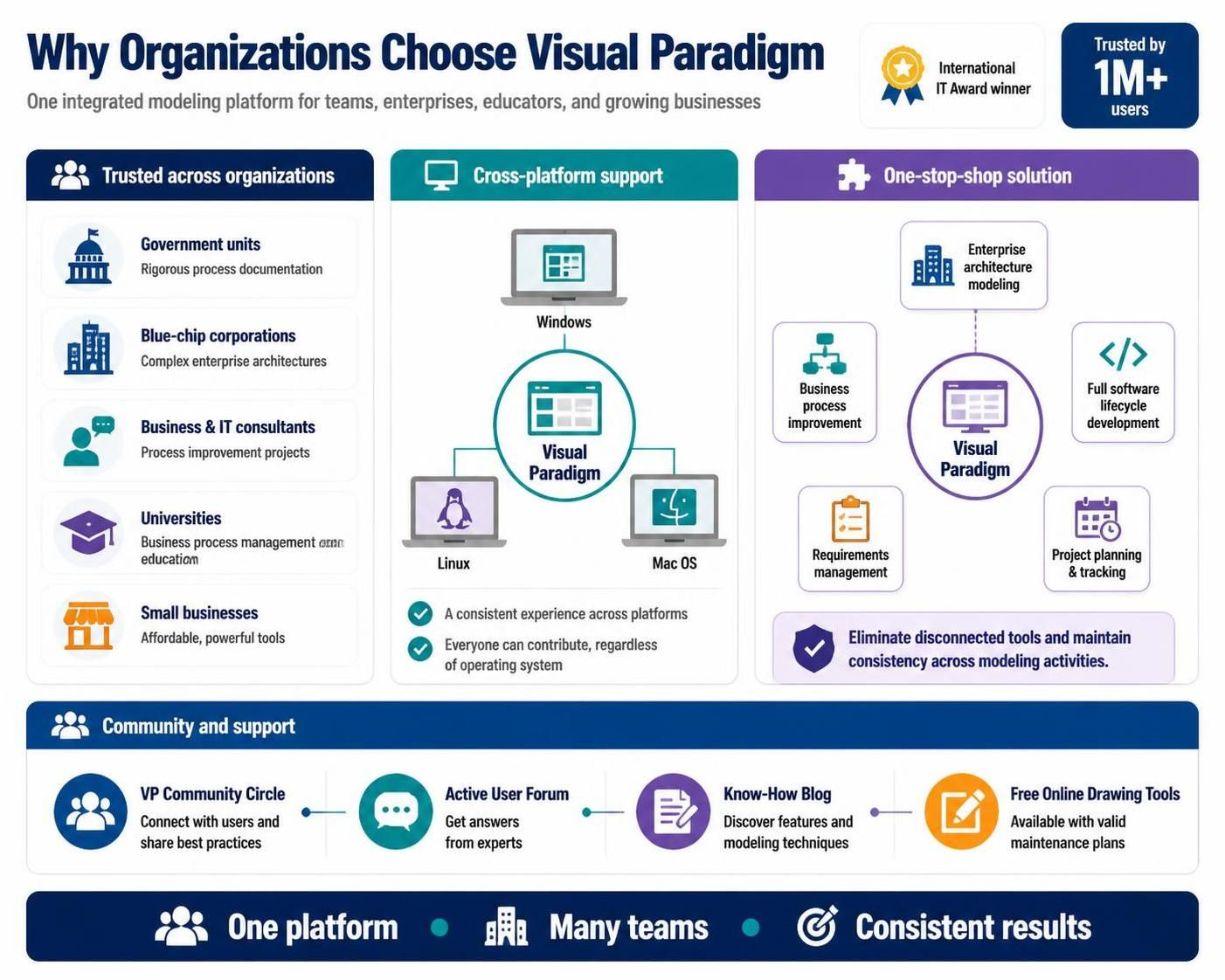
In the complex landscape of modern software development and business operations, organizations often struggle with fragmented tools that create silos between architecture, process design, and project management. Visual Paradigm emerges as a critical solution for bridging these gaps. This tutorial explores the core architectural philosophy of the platform, specifically focusing on its Business Process Model and Notation (BPMN) capabilities and how it functions as a comprehensive, cross-platform ecosystem for professional modeling.
The Architecture of a Unified Modeling Platform
Visual Paradigm is not merely a diagramming tool; it is an integrated suite designed to support the entire software lifecycle. Its architecture is built on the premise that business needs, IT architecture, and process improvements are inextricably linked. By consolidating these functions into a single environment, the platform eliminates the “translation errors” that often occur when moving data between disconnected applications.
Core Architectural Pillars
The system is organized around four primary pillars that ensure consistency and efficiency across teams:
- Enterprise Architecture Modeling: Provides high-level views of organizational structure and IT infrastructure.
- Business Process Improvement: Focuses on BPMN 2.0 standards to visualize and optimize workflows.
- Full Software Lifecycle Development: Supports requirements management and project planning.
- Cross-Platform Accessibility: Ensures that the modeling experience is identical whether the user is on Windows, Linux, or Mac OS.
This “One-Stop-Shop” approach allows diverse teams—such as government units requiring rigorous documentation, blue-chip corporations managing complex architectures, and universities teaching process management—to collaborate without compatibility issues.
Deep Dive: BPMN 2.0 in Visual Paradigm
Business Process Model and Notation (BPMN) is the industry standard for business process modeling. Visual Paradigm offers full support for BPMN 2.0, providing capabilities that go far beyond simple static diagramming. It transforms processes from static documentation into dynamic assets.
Key Features of the BPMN Engine
When utilizing Visual Paradigm for BPMN modeling, you unlock several advanced capabilities:
- Intuitive Diagramming: The interface allows for drag-and-drop creation of complex process flows, adhering strictly to BPMN 2.0 syntax rules.
- Advanced Analysis: Unlike basic drawing tools, Visual Paradigm supports process animation and simulation. This allows architects to test workflows, identify bottlenecks, and validate logic before implementation.
- Automated Reporting: The system can generate customizable reports from the models, ensuring that stakeholders receive up-to-date documentation automatically.
- Centralized Glossary Management: Ensures consistent terminology across all models, which is crucial for large-scale enterprise projects.
Seamless Integration with Other Standards
A critical advantage of the Visual Paradigm architecture is its ability to integrate BPMN with other modeling standards. The platform supports:
- UML (Unified Modeling Language): For detailed software architecture design.
- Mind Maps: For brainstorming and initial requirement gathering.
- Decision Tables: For defining complex business rules.
This integration ensures that a business process defined in BPMN can be seamlessly linked to the underlying software architecture defined in UML, creating a cohesive “single source of truth.”
Collaborative and Community-Driven Support
Successful implementation of a modeling tool requires more than just software; it requires a support ecosystem. Visual Paradigm fosters a global community of over a million users through several dedicated channels:
- VP Community Circle: A network for connecting with other users to share best practices.
- Active User Forum: A place to get specific technical answers from experts.
- Know-How Blog: Resources to stay updated on new features and advanced modeling techniques.
- Free Online Drawing Tools: Accessible for users with valid maintenance plans, allowing for quick prototyping.
Conclusion: From Static Documentation to Dynamic Assets
The true value of BPMN is realized only when supported by comprehensive tools that facilitate continuous improvement. By leveraging Visual Paradigm’s sophisticated BPMN tools, organizations can transform their processes.
Whether you are a business analyst documenting current workflows, a process architect designing future-state operations, or a project manager coordinating cross-functional improvements, Visual Paradigm provides the necessary tools to succeed. The combination of powerful modeling capabilities, analytical tools, and collaborative features enables teams to design better processes, communicate more effectively, and deliver measurable business results.
Ready to transform your business processes? Explore Visual Paradigm’s BPMN tools and join the millions of professionals who have already discovered the power of visual process modeling. Start modeling smarter today to experience how better processes lead to lower costs, higher revenues, and happier customers.