
Mastering Motivation Extension: Connecting Strategic Goals to Architecture with ArchiMate
In the complex world of Enterprise Architecture (EA), a common pitfall is creating beautiful diagrams that lack context. You might have a detailed view of systems and applications, but if you cannot explain why they exist, the architecture is merely a map without a destination. This is where the Motivation Extension comes into play.
Motivation elements are the glue that binds business strategy to technical implementation. They allow architects to trace a line of reasoning from high-level corporate drivers down to the specific software requirements. In this tutorial, we will dissect a typical Motivation Diagram, often created using tools like Visual Paradigm, to understand how to model the “Why” behind the “What.”
Understanding the Core Concept
The Motivation Extension introduces a specialized layer to the ArchiMate standard. While the core layers (Business, Application, Technology) describe the static structure of the enterprise, the Motivation layer describes the rationale.
Think of it as the legal brief for your architecture. It answers questions like:
- What is the company trying to achieve?
- What is stopping us from achieving it?
- How does this specific server configuration help us?
Deconstructing the Diagram Elements
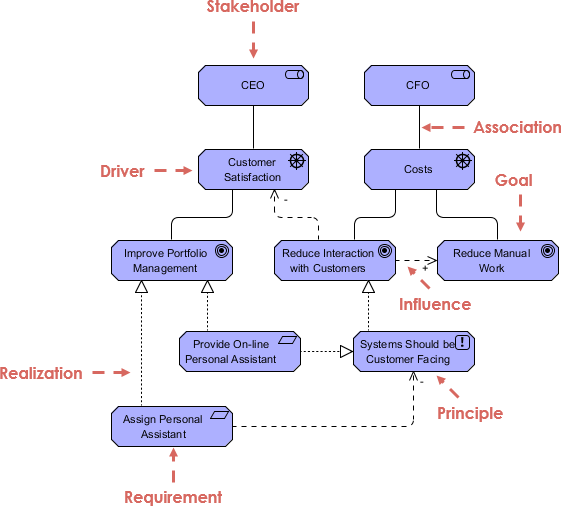
Let’s analyze the specific components found in the diagram above, moving from the abstract top layer down to the concrete implementation.
1. The Strategic Layer: Drivers and Goals
At the very top, we identify the Stakeholders—the individuals with the power to make decisions. In the diagram, we see a CEO and a CFO. Their relationship to the architecture is defined by Drivers and Goals.
- Driver (Stimulus): This represents a problem, a threat, or an opportunity that triggers change. For example, “Customer Satisfaction” is shown as a driver. It is the “pain” the organization feels.
- Goal (Objective): This is the desired outcome. “Reduce Manual Work” is a classic goal. It represents the “cure” or the improvement sought.
2. The Tactical Layer: Assessments and Principles
Bridging the gap between high-level strategy and low-level implementation are Assessments and Principles.
- Assessment: This element analyzes the situation and proposes a solution. In the diagram, elements like “Improve Portfolio Management” are assessments. They are the strategic actions taken to address the drivers.
- Principle: A principle is a rule or guideline that restricts or guides behavior. For example, “Systems Should be Customer Facing” acts as a design constraint or rule that all future applications must adhere to.
3. The Implementation Layer: Requirements
Finally, we reach the concrete needs of the system. A Requirement is a condition or capability that must be met by the system. In the diagram, “Assign Personal Assistant” is a requirement. It is a specific feature or function that must be built to satisfy the higher-level goals.
The Power of Relationships
The real magic of the Motivation Extension lies not in the elements themselves, but in the relationships connecting them. These arrows tell the story of the architecture.
The diagram illustrates several critical relationship types:
Realization
This is the most crucial relationship in architecture. It answers “How is this achieved?”
Requirement (Assign Personal Assistant) --[Realization]--> Assessment (Improve Portfolio Management)
In the diagram, notice how the Requirement “Assign Personal Assistant” realizes the Assessment “Improve Portfolio Management.” This means that by building the feature to assign assistants, the organization effectively improves its portfolio management.
Influence
Influence is used when one element affects another but does not directly realize it. It often implies a constraint or a supporting factor.
Principle (Systems Should be Customer Facing) --[Influence]--> Assessment (Reduce Interaction with Customers)
This relationship suggests a tension or a specific condition: the principle that systems must be customer-facing influences how we handle the goal of reducing manual interaction.
Association
Simple associations link elements that are related but do not have a direct causal link (like Realization). This is often used to link a Stakeholder directly to a Goal.
Practical Application: Building the Argument
When you use this diagram in a presentation or a design document, you are building a logical argument. You are not just saying “We need a new app.” You are saying:
- The CFO is concerned about Costs (Driver).
- We want to Reduce Manual Work (Goal) to address these costs.
- To do this, we need to Reduce Interaction with Customers (Assessment).
- This assessment requires a system that Should be Customer Facing (Principle).
- Therefore, we have a Requirement to Assign a Personal Assistant (Requirement).
This chain of logic is what convinces stakeholders that the architecture is sound and strategically aligned.
Conclusion
The Motivation Extension transforms architecture from a static blueprint into a dynamic narrative. By explicitly modeling Drivers, Goals, Assessments, and Requirements, and linking them through Realization and Influence, you ensure that every line of code and every server rack serves a strategic purpose. As you continue your journey in Enterprise Architecture, remember that while the technology changes, the motivation remains the guiding star.