
Modeling Concurrent Workflows in VPasCode: UML Activity Diagrams
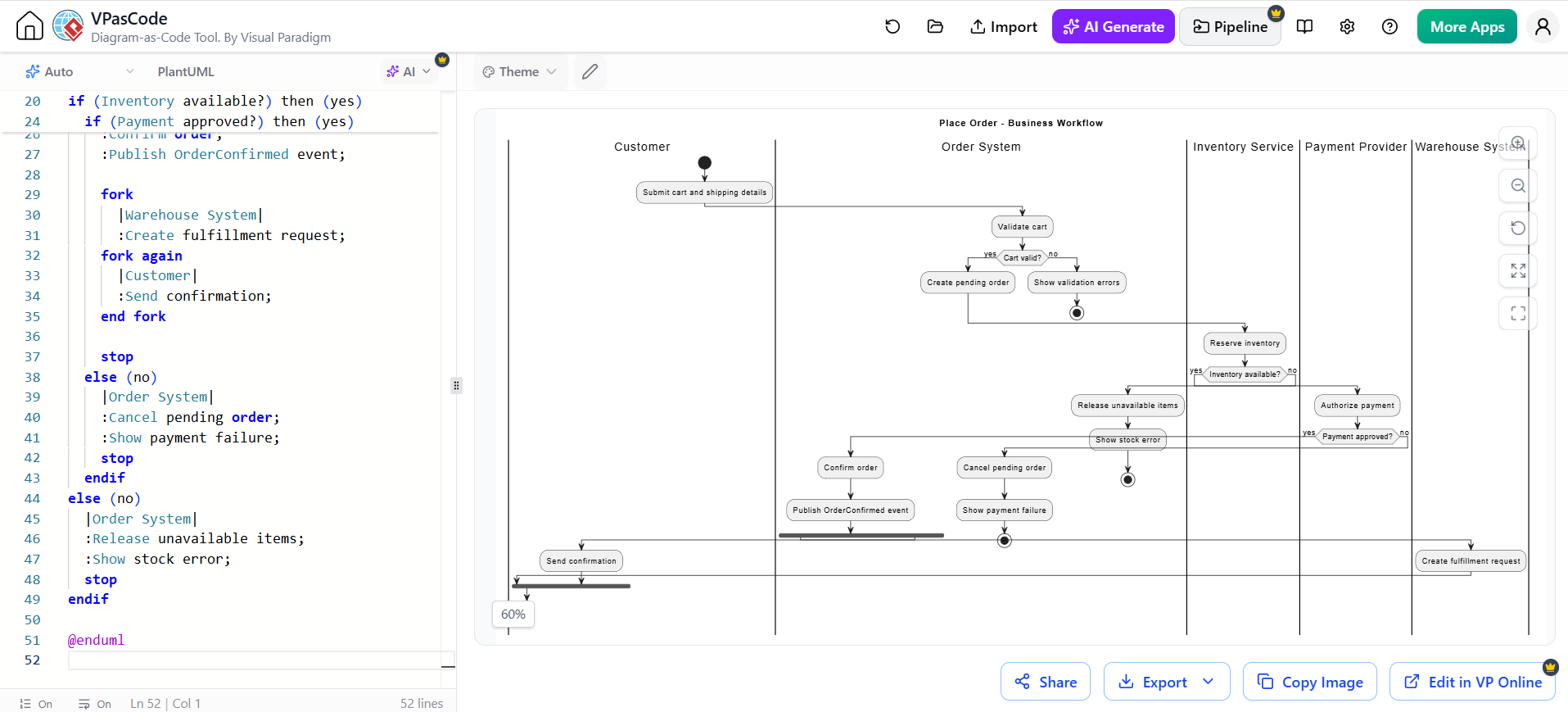
In the realm of software architecture and business process modeling, few scenarios are as challenging as handling parallel tasks and conditional branching simultaneously. When a user action—like placing an order—triggers multiple independent backend processes (inventory checks, payment validation, confirmation emails), the system architecture must manage these threads of execution seamlessly.
This tutorial explores how to model a sophisticated “Place Order” business workflow using Activity Diagrams within the VPasCode tool. We will focus on the power of the fork and end fork constructs to represent concurrent activities, ensuring your models accurately reflect the real-world complexity of distributed systems.
The Power of Activity Diagrams in Business Logic
Activity diagrams are the gold standard for visualizing the flow of control from one activity to another. Unlike simple flowcharts, UML activity diagrams are equipped to handle:
- Swimlanes: Clearly defining responsibility across different actors (e.g., Customer, Order System, Inventory Service).
- Concurrency: Showing where processes happen simultaneously using
forkandjoinnodes. - Complex Decision Logic: Handling nested “if-else” scenarios with precision.
When using VPasCode, the magic lies in translating this visual complexity into text-based code. This allows for version control, AI-assisted generation, and rapid iteration.
Step-by-Step: Modeling the “Place Order” Workflow
Let’s break down the workflow logic shown in the provided context. The goal is to create a robust process that validates an order, reserves inventory, and authorizes payment.
1. Setting the Stage: Decision Logic
Every complex workflow begins with a decision. In our scenario, the system must first verify if the inventory is available. This is the primary entry point for our conditional logic.
if (Inventory available?) then (yes)
  if (Payment approved?) then (yes)
    :Confirm order;
    :Publish OrderConfirmed event;
Here, we see a nested if structure. This isn’t just about “Yes” or “No”; it’s about the sequence of checks. The system checks inventory first, then payment.
2. The Critical Concept: Fork and Join for Concurrency
Once the order is confirmed, the system doesn’t necessarily need to wait for one task to finish before starting the next. In modern systems, we often want to run tasks in parallel.
The code snippet below demonstrates the fork construct. This tells the activity diagram to split the control flow into multiple simultaneous paths.
fork
  |Warehouse system|
  :Create fulfillment request;
fork again
  |Customer|
  :Send confirmation;
end fork
In this specific example, we have a fork again block. This implies that we are creating a nested level of concurrency or managing distinct threads within the parallel execution. The “Warehouse system” creates a fulfillment request while, simultaneously, the “Customer” receives a confirmation. Both happen at the same time, optimizing the user experience.
3. Handling the “No” Scenarios
A robust model must account for failure. If inventory is missing or payment fails, the system must gracefully handle the error.
else (no)
  |Order System|
  :Cancel pending order;
  :Show payment failure;
  stop
endif
This block acts as the safety net. It ensures that if the initial checks fail, the order is not left in a “pending” limbo state, and the user is informed immediately.
Visualizing the Swimlanes
One of the most powerful features of VPasCode is its ability to render swimlanes directly from the code. Notice how the code assigns specific actions to specific entities:
|Warehouse system|: This creates a vertical lane dedicated to inventory management.|Order System|: This lane handles the core logic and cancellation.|Customer|: This lane represents the user’s interface and notifications.
When rendered, these lanes visually separate the responsibilities, making it easy for stakeholders to see which system is responsible for which step.
Conclusion
Modeling complex business processes requires a tool that can handle both the visual clarity of a diagram and the structural rigidity of code. By leveraging VPasCode’s activity diagram capabilities, specifically the fork and if constructs, architects can design systems that are not only logically sound but also visually intuitive.
Whether you are designing a batch job, an approval workflow, or a multi-step e-commerce transaction, the principles of concurrency and swimlane separation remain the same. Start coding your next workflow today.