
Visual Paradigm AI Chatbot vs. General LLMs: A Technical Architecture Analysis
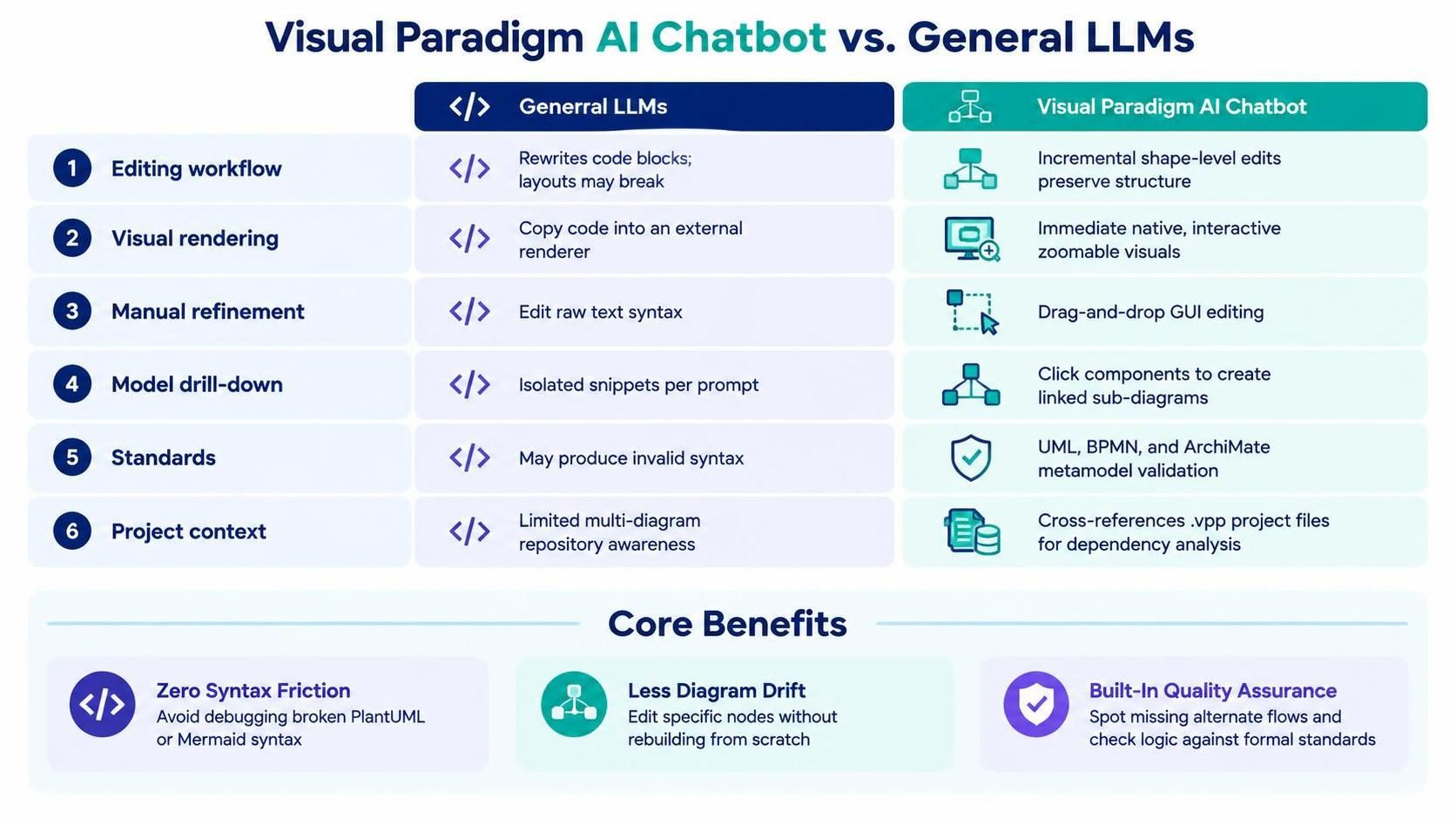
In the rapidly evolving landscape of software engineering and enterprise architecture, the role of Artificial Intelligence has shifted from simple text generation to complex reasoning and system modeling. A critical distinction exists between general-purpose Large Language Models (LLMs) and specialized modeling engines like the Visual Paradigm AI Chatbot. Understanding this difference is essential for architects who require precision, structural integrity, and adherence to formal standards.
The Fundamental Architectural Difference
At a high level, general LLMs function primarily as probabilistic text predictors. When you ask a standard AI to create a diagram, it generates text (such as PlantUML or Mermaid syntax) based on patterns it has learned. The AI does not inherently understand the visual structure; it only understands the code language used to describe it.
In contrast, the Visual Paradigm AI Chatbot functions as a native modeling engine. It does not merely predict text; it understands the underlying metamodels—formal definitions of structure and behavior used in UML, BPMN, and ArchiMate. This fundamental difference dictates how the system handles editing, rendering, and validation.
1. The Editing Workflow: Regeneration vs. Incrementalism
One of the most significant friction points in AI-assisted modeling is the editing workflow. General LLMs often treat a diagram as a single block of code. When a user requests a change, the model frequently regenerates the entire code block to include the new information.
- General LLM Approach: The system discards the previous state and outputs a new, complete script. This often leads to “layout drift,” where the visual arrangement of the diagram changes unpredictably, and the user must manually re-arrange elements to make sense of the new output.
- Visual Paradigm Approach: The AI utilizes an incremental, shape-level update mechanism. When a user requests a change, the system identifies the specific nodes or edges involved and applies the modification locally. This preserves the existing layout and structural relationships, ensuring the diagram remains stable and coherent.
2. Visual Rendering and User Interaction
The rendering pipeline determines how quickly an architect can iterate on an idea. General LLMs are disconnected from the visual rendering engine. They output text that the user must copy, paste into a renderer, and then view.
The Visual Paradigm AI Chatbot integrates directly with the rendering engine. It produces native, interactive visuals that are immediately available in a zoomable viewer. This allows for a seamless workflow where the AI acts as a co-pilot within the environment, rather than an external text generator.
3. Standards Enforcement and Metamodel Validation
Enterprise architecture relies heavily on strict standards. UML (Unified Modeling Language), BPMN (Business Process Model and Notation), and ArchiMate are not just drawing tools; they are rigorous formal languages with specific rules governing syntax and semantics.
General LLMs often hallucinate syntax or produce invalid structures because they are optimizing for linguistic coherence rather than structural validity. The Visual Paradigm AI Chatbot, however, enforces formal metamodel rules. It acts as a built-in quality assurance mechanism, ensuring that every generated element adheres to the strict definitions of the chosen modeling standard.
Core Benefits: From Text to Architecture
The transition from using a general text model to a specialized modeling chatbot offers three distinct benefits for professional architects:
- Zero Syntax Friction: Teams can bypass the tedious process of debugging broken syntax in tools like PlantUML or Mermaid. The AI handles the technical details, allowing the architect to focus on the logic.
- Elimination of Diagram Drift: Because edits are applied incrementally, the “mental map” of the system is preserved. Architects can refine specific nodes without rebuilding the entire diagram from scratch.
- Built-In Quality Assurance: The AI acts as an architectural reviewer. It can spot missing alternate flows, validate logic against formal standards, and ensure the diagram accurately represents the intended system behavior.
Conclusion
While general LLMs are powerful tools for text generation and brainstorming, they lack the structural intelligence required for complex system modeling. The Visual Paradigm AI Chatbot bridges the gap between conversational AI and rigorous engineering by treating diagrams as editable, interactive objects rather than static text blocks. This shift empowers architects to maintain high standards of quality and consistency while accelerating the design process.