
VP OpenDocs: AI-Driven Knowledge Synthesis & Visual Modeling
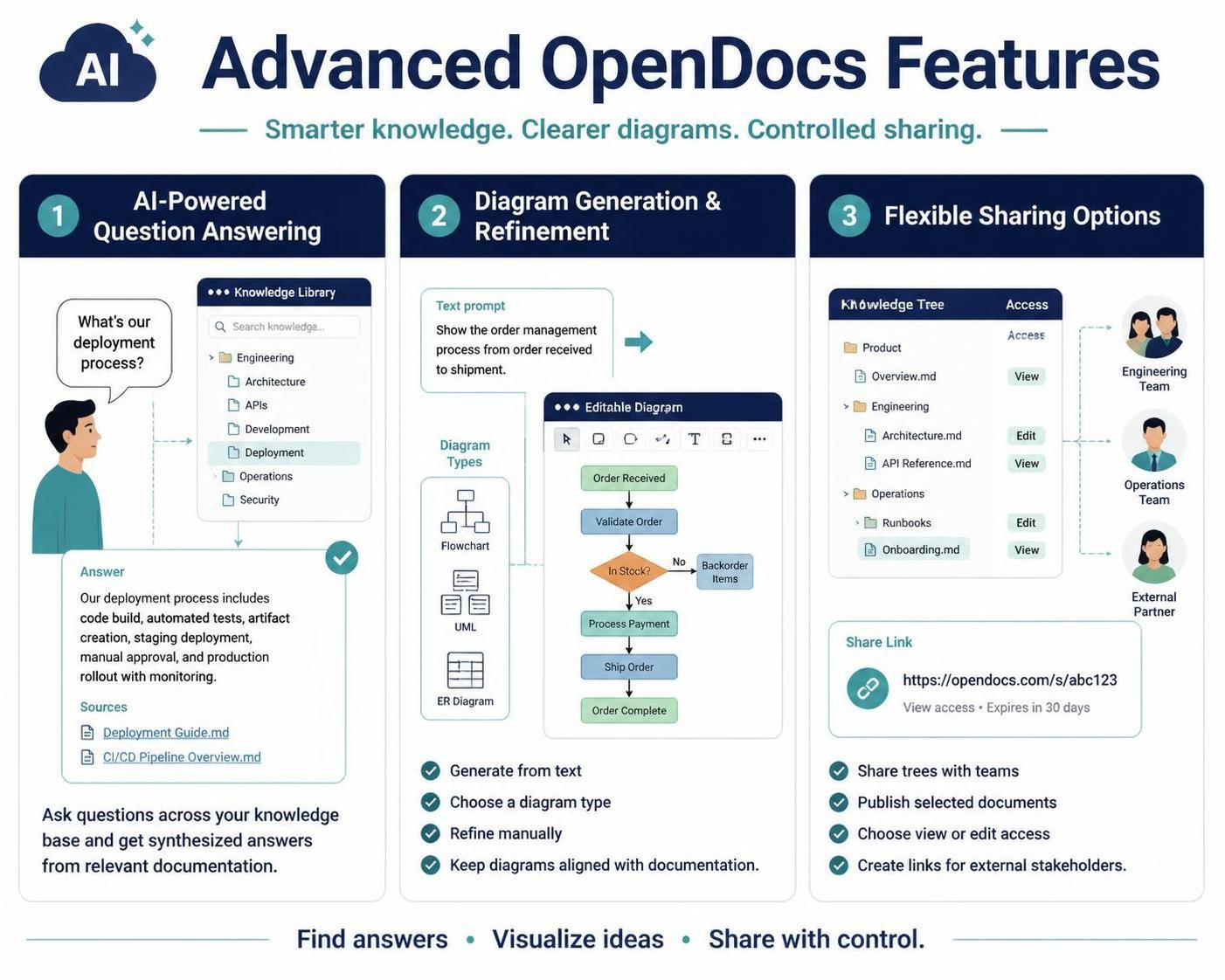
Welcome to this comprehensive guide on leveraging OpenDocs, a platform that represents a significant evolution in how technical teams manage collective intelligence. This tutorial breaks down the advanced features illustrated in the system architecture diagram, specifically focusing on the integration of AI-driven retrieval, automated diagram generation, and granular security models.
1. AI-Powered Question Answering (RAG Architecture)
The first pillar of OpenDocs is its ability to act as a semantic search engine rather than a simple keyword retriever. This feature utilizes a Retrieval-Augmented Generation (RAG) architecture. Instead of relying on pre-trained static knowledge, the system dynamically searches your specific “Knowledge Library” to synthesize answers.
How it works:
- Input: A team member asks a natural language question, such as “What’s our deployment process?”.
- Retrieval: The system scans indexed documents within the Knowledge Library (e.g.,
Engineering/AI/Deploymentfolders). - Synthesis: The AI aggregates relevant snippets from multiple sources, such as
Deployment Guide.mdandCI/CD Pipeline Overview.md. - Output: A coherent, summarized answer is generated, citing the specific sources used.
This approach solves the problem of information silos, ensuring that answers are always grounded in the most current documentation available.
2. Diagram Generation and Refinement
Visualizing complex logic is often a bottleneck in documentation. OpenDocs addresses this by bridging the gap between text descriptions and formal modeling languages (like Mermaid or PlantUML).
The Modeling Workflow
- Text-to-Diagram Conversion: You provide a text prompt describing a process. For example: “Show the order management process from order received to shipment.”
- Diagram Type Selection: The system supports various types, including Flowcharts for processes, UML for system structures, and ER Diagrams for data relationships.
- AI Generation: The engine parses the prompt and generates a structured diagram. In the example provided, it creates a flow starting with “Order Received” and branching at “In Stock?”.
- Manual Refinement: The AI is not the final authority; it is a co-pilot. You can manually adjust nodes, change logic paths (e.g., the “No” branch going to “Backorder Items”), and refine aesthetics.
- Synchronization: Crucially, these diagrams remain linked to the documentation. If the text description changes, the diagram can be updated to stay synchronized.
3. Flexible Sharing Options & Access Control
Knowledge is only valuable if it reaches the right people. OpenDocs implements a hierarchical access control model that allows for precise management of intellectual property and operational data.
The Knowledge Tree Structure
The system organizes data into a tree structure where permissions can be inherited or overridden at specific nodes.
- Engineering Team: Granted Edit access to
Architecture.mdandAPI Reference.md. - Operations Team: Granted Edit access to
Runbooksand View access toOverview.md. - External Partners: Typically restricted to read-only views or specific shared links to ensure data security.
Shareable Links
For stakeholders who do not have full system access, OpenDocs supports time-bound shareable links. This feature allows you to generate a URL (e.g., https://opendocs.com/s/abc123) that grants temporary access to specific documents or trees, often expiring after a set period (e.g., 30 days) to mitigate security risks.
Conclusion: Building a Living Knowledge Ecosystem
The true power of OpenDocs lies not just in these individual features, but in their integration. By combining intuitive hierarchical organization with powerful AI assistance and robust collaboration features, it transforms scattered information into a living, breathing knowledge platform.
The key to success is adopting a mindset where knowledge sharing becomes integral to your team’s workflow. Start small, focus on high-value areas like deployment processes or API documentation, and gradually build out your knowledge tree as your team experiences the benefits of having a true single source of truth.