


Introduction
In today’s rapidly evolving digital landscape, software systems have become the backbone of organizational strategy, operational efficiency, and competitive advantage. As applications grow in complexity—spanning distributed architectures, cloud-native deployments, real-time processing, and AI integration—the challenge of designing, communicating, and maintaining these systems has never been greater. Without a shared visual language, development teams risk misalignment, architectural drift, and costly rework.
Enter the Unified Modeling Language (UML): a standardized, expressive, and industry-adopted framework for visualizing, specifying, constructing, and documenting software-intensive systems. Born from the convergence of leading object-oriented methodologies and formalized under the Object Management Group (OMG), UML has matured into an indispensable tool for architects, developers, business analysts, and stakeholders alike. This case study explores UML’s foundational principles, historical evolution, practical scope, and modern tooling ecosystems—demonstrating why it remains a cornerstone of disciplined software engineering in an era of accelerating technological change.
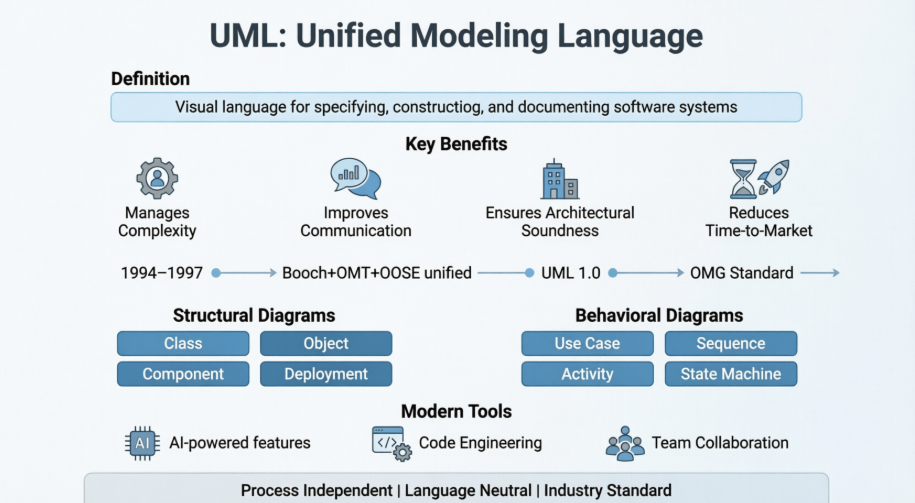
What Is UML and Why Is It Important?
As the strategic value of software increases for many companies, the industry looks for techniques to automate the production of software and to improve quality and reduce cost and time-to-market. These techniques include component technology, visual programming, patterns and frameworks. Businesses also seek techniques to manage the complexity of systems as they increase in scope and scale. In particular, they recognize the need to solve recurring architectural problems, such as physical distribution, concurrency, replication, security, load balancing and fault tolerance. Additionally, the development for the World Wide Web, while making some things simpler, has exacerbated these architectural problems. The Unified Modeling Language (UML) was designed to respond to these needs.
The Unified Modeling Language (UML) is a language for specifying, visualizing, constructing, and documenting the artifacts of software systems, as well as for business modeling and other non-software systems. The UML represents a collection of best engineering practices that have proven successful in the modeling of large and complex systems.
The UML was developed by Rational Software and its partners. It is the successor to the modeling languages found in the Booch, OOSE/Jacobson, OMT and other methods. Many companies are incorporating the UML as a standard into their development processes and products, which cover disciplines such as business modeling, requirements management, analysis & design, programming and testing.
The Importance Of Modeling
Developing a model for an industrial-strength software system prior to its construction or renovation is as essential as having a blueprint for a building. Good models are essential for communication among project teams and to assure architectural soundness. As the complexity of systems increases, so does the importance of good modeling techniques. There are many additional factors of a project’s success, but having a rigorous modeling language standard is essential.
A modeling language must include:
-
Model elements — fundamental modeling concepts and semantics.
-
Notation — visual rendering of model elements.
-
Guidelines — idioms of usage within the trade.
In the face of increasingly complex systems, visualization and modeling become essential. The UML is a well-defined and widely accepted response to that need. It is the visual modeling language of choice for building object-oriented and component-based systems.
Goals of the UML
The primary goals in the design of the UML were as follows:
-
Provide users with a ready-to-use, expressive visual modeling language so they can develop and exchange meaningful models.
-
Provide extensibility and specialization mechanisms to extend the core concepts.
-
Be independent of particular programming languages and development processes.
-
Provide a formal basis for understanding the modeling language.
-
Encourage the growth of the OO tools market.
-
Support higher-level development concepts such as collaborations, frameworks, patterns and components.
-
Integrate best practices.
Scope of the OMG-UML
The Unified Modeling Language (UML) is a language for specifying, constructing, visualizing, and documenting the artifacts of a software-intensive system. First and foremost, the Unified Modeling Language fuses the concepts of Booch, OMT and OOSE. The result is a single, common, and widely usable modeling language for users of these and other methods.
Second, the Unified Modeling Language pushes the envelope of what can be done with existing methods. As an example, the UML authors targeted the modeling of concurrent, distributed systems to assure that the UML adequately addresses these domains.
Third, the Unified Modeling Language focuses on a standard modeling language, not a standard process. Although the UML must be applied in the context of a process, experience has shown that different organizations and problem domains require different processes. (For example, the development process for shrink-wrapped software is an interesting one, but building shrink-wrapped software is vastly different from building hard-real-time avionics systems upon which lives depend.) Therefore, the efforts concentrated first on a common metamodel (which unifies semantics) and second on a common notation (which provides a human rendering of these semantics). The UML authors promote a development process that is use-case driven, architecture centric, and iterative and incremental.
Outside The Scope of the UML
While the UML aims to simplify and standardize modeling it is not an all encompassing language. This gives it the flexibility to be used to design a variety of systems over a wide spectrum of industries. Some major areas outside of the scope of the UML include:
Programming Languages
The UML, a visual modeling language, is not intended to be a visual programming language*,* in the sense of having all the necessary visual and semantic support to replace programming languages. The UML is a language for visualizing, specifying, constructing, and documenting the artifacts of a software-intensive system, but it does draw the line as you move toward code. The UML does have a tight mapping to a family of OO languages, so that you can get the best of both worlds.
Tools
Standardizing a language is necessarily the foundation for tools and process. The primary goal of the OMG RFP was to enable tool interoperability. However, tools and their interoperability are very dependent on a solid semantic and notation definition, such as the UML provides. The UML defines a semantic metamodel, not a tool interface, storage, or run-time model, although these should be fairly close to one another.
Process
Many organizations will use the UML as a common language for their project artifacts, but they will use the same UML diagram types in the context of different processes. The UML is intentionally process independent, and defining a standard process was not a goal of the UML or OMG’s RFP.
Origin of UML and How It Became An OMG Standard
Identifiable object-oriented modeling languages began to appear between mid-1970 and the late 1980s as various methodologists experimented with different approaches to object-oriented analysis and design. The number of identified modeling languages increased from less than 10 to more than 50 during the period between 1989-1994. Many users of OO methods had trouble finding complete satisfaction in any one modeling language, fueling the “method wars.” By the mid-1990s, new iterations of these methods began to appear and these methods began to incorporate each other’s techniques, and a few clearly prominent methods emerged.
The development of UML began in late 1994 when Grady Booch and Jim Rumbaugh of Rational Software Corporation began their work on unifying the Booch and OMT (Object Modeling Technique) methods. In the Fall of 1995, Ivar Jacobson and his Objectory company joined Rational and this unification effort, merging in the OOSE (Object-Oriented Software Engineering) method.
As the primary authors of the Booch, OMT, and OOSE methods, Grady Booch, Jim Rumbaugh, and Ivar Jacobson were motivated to create a unified modeling language for three reasons. First, these methods were already evolving toward each other independently. It made sense to continue that evolution together rather than apart, eliminating the potential for any unnecessary and gratuitous differences that would further confuse users. Second, by unifying the semantics and notation, they could bring some stability to the object-oriented marketplace, allowing projects to settle on one mature modeling language and letting tool builders focus on delivering more useful features. Third, they expected that their collaboration would yield improvements in all three earlier methods, helping them to capture lessons learned and to address problems that none of their methods previously handled well.
As they began their unification, they established four goals to focus their efforts:
-
Enable the modeling of systems (and not just software) using object-oriented concepts.
-
Establish an explicit coupling to conceptual as well as executable artifacts.
-
Address the issues of scale inherent in complex, mission-critical systems.
-
Create a modeling language usable by both humans and machines.
The efforts of Booch, Rumbaugh, and Jacobson resulted in the release of the UML 0.9 and 0.91 documents in June and October of 1996. During 1996, the UML authors invited and received feedback from the general community. They incorporated this feedback, but it was clear that additional focused attention was still required.
While Rational was bringing UML together, efforts were being made on achieving the broader goal of an industry standard modeling language. In early 1995, Ivar Jacobson (then Chief Technology Officer of Objectory) and Richard Soley (then Chief Technology Officer of OMG) decided to push harder to achieve standardization in the methods marketplace. In June 1995, an OMG-hosted meeting of all major methodologists (or their representatives) resulted in the first worldwide agreement to seek methodology standards, under the aegis of the OMG process.
During 1996, it became clear that several organizations saw UML as strategic to their business. A Request for Proposal (RFP) issued by the Object Management Group (OMG) provided the catalyst for these organizations to join forces around producing a joint RFP response. Rational established the UML Partners consortium with several organizations willing to dedicate resources to work toward a strong UML 1.0 definition. Those contributing most to the UML 1.0 definition included: Digital Equipment Corp., HP, i-Logix, IntelliCorp, IBM, ICON Computing, MCI Systemhouse, Microsoft, Oracle, Rational Software, TI, and Unisys. This collaboration produced UML 1.0, a modeling language that was well defined, expressive, powerful, and generally applicable. This was submitted to the OMG in January 1997 as an initial RFP response.
In January 1997 IBM, ObjecTime, Platinum Technology, Ptech, Taskon, Reich Technologies and Softeam also submitted separate RFP responses to the OMG. These companies joined the UML partners to contribute their ideas, and together the partners produced the revised UML 1.1 response. The focus of the UML 1.1 release was to improve the clarity of the UML 1.0 semantics and to incorporate contributions from the new partners. It was submitted to the OMG for their consideration and adopted in the fall of 1997.
UML Present and Future
The UML is nonproprietary and open to all. It addresses the needs of user and scientific communities, as established by experience with the underlying methods on which it is based. Many methodologists, organizations, and tool vendors have committed to use it. Since the UML builds upon similar semantics and notation from Booch, OMT, OOSE, and other leading methods and has incorporated input from the UML partners and feedback from the general public, widespread adoption of the UML should be straightforward.
There are two aspects of “unified” that the UML achieves: First, it effectively ends many of the differences, often inconsequential, between the modeling languages of previous methods. Secondly, and perhaps more importantly, it unifies the perspectives among many different kinds of systems (business versus software), development phases (requirements analysis, design and implementation), and internal concepts.
Although the UML defines a precise language, it is not a barrier to future improvements in modeling concepts. We have addressed many leading-edge techniques, but expect additional techniques to influence future versions of the UML. Many advanced techniques can be defined using UML as a base. The UML can be extended without redefining the UML core.
The UML, in its current form, is expected to be the basis for many tools, including those for visual modeling, simulation and development environments. As interesting tool integrations are developed, implementation standards based on the UML will become increasingly available.
The Meta Object Facility
The main purpose of the OMG MOF is to provide a set of CORBA interfaces that can be used to define and manipulate a set of interoperable metamodels. The MOF is a key building block in the construction of CORBA-based distributed development environments.
The Meta Object Facility represents the integration of work currently underway by the OMG members in the areas of object repositories, object modeling tools, and meta data management in distributed object environments. The MOF specification uses the Unified Modeling Language (UML) notation. The facility interface and semantics incorporate some of the advanced meta data management concepts that have been implemented in the commercial object repositories, development tools, and object framework products developed by the co-submitters.
The specification enhances meta data management and meta data interoperability in distributed object environments in general and in distributed development environments in particular. While the initial work addresses meta data interoperability in object analysis and design domain, it is anticipated that the MOF will be rich enough to support additional domains. Examples include metamodels that cover the application development life cycle as well as additional domains such as data warehouse management and business object management. OMG is expected to issue new RFPs to cover these additional domains.
Visual Paradigm: A Comprehensive UML Tool Platform
Visual Paradigm provides industry-standard, comprehensive UML 2.x support featuring all 14 official UML diagram types. It acts as a multi-purpose software design platform that connects visual modeling directly to code engineering, database architecture, and team workflows.
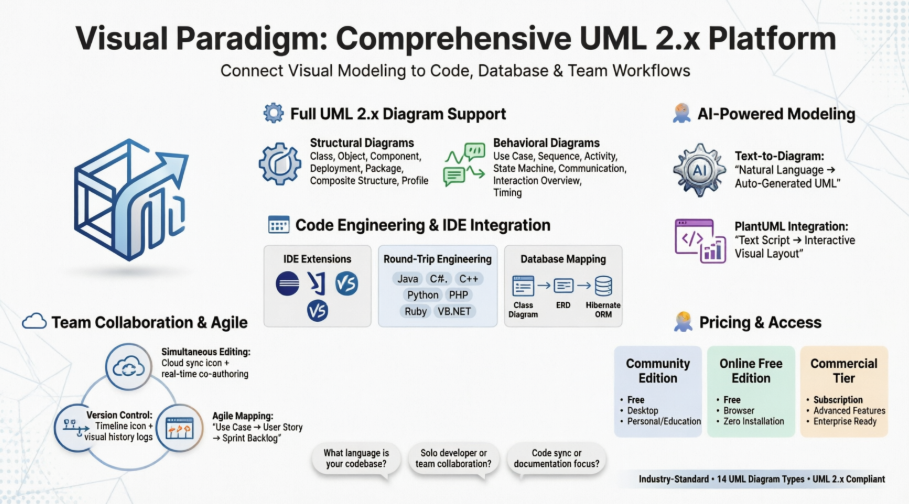
🛠️ Full UML 2.x Diagram Support
The platform fully supports both structural and behavioral modeling paradigms:
-
Structural Diagrams: Class, Object, Component, Deployment, Package, Composite Structure, and Profile diagrams.
-
Behavioral Diagrams: Use Case, Sequence, Activity, State Machine, Communication, Interaction Overview, and Timing diagrams.
💻 Code Engineering & IDE Integration
Visual Paradigm synchronizes visual models directly with your development environment:
-
IDE Extensions: Embedded functionality inside major environments like Eclipse, IntelliJ IDEA, NetBeans, Visual Studio, and Android Studio.
-
Round-Trip Engineering: Generate boilerplate source code from your class diagrams, or reverse engineer existing codebases back into visual UML classes. Supported languages include Java, C#, C++, Python, PHP, Ruby, and VB.NET.
-
Database Mapping: Direct linking of Class Diagrams to Entity Relationship Diagrams (ERDs) and generation of Hibernate ORM mapping tiers.
🤖 AI-Powered Modeling
The platform incorporates artificial intelligence features to speed up documentation and layout creation:
-
Text-to-Diagram Generation: Input natural language descriptions of system logic to automatically output structural or behavioral diagrams.
-
PlantUML Integration: Import standard text-based PlantUML script configurations and instantly convert them into interactive visual layouts.
👥 Team Collaboration & Agile Frameworks
-
Simultaneous Editing: Real-time cloud-based co-authoring and commenting tools via Visual Paradigm Cloud.
-
Agile Mapping: Directly trace and link UML Use Cases to Scrum user stories, sprint backlogs, and wireframe user interfaces.
-
Version Control: Built-in visual history logs to track changes, compare iterations, and revert models back to prior stages.
💰 Pricing & Access Options
-
Community Edition: A completely free desktop version intended strictly for personal, student, and educational use.
-
Visual Paradigm Online (Free Edition): A browser-based alternative for fast web sketching with zero installations.
-
Commercial Tier: Paid licensing models unlocking advanced team collaboration features, enterprise architecture tools, and full code generation starting at a monthly subscription rate.
If you are evaluating this platform for a specific software project, consider:
-
What programming language is your code repository written in?
-
Do you need collaborative team access, or are you a solo developer?
-
Are you looking for automatic code synchronization, or do you just need clean diagrams for documentation?
Conclusion
The Unified Modeling Language stands as a testament to the power of collaboration, standardization, and forward-thinking design in software engineering. By unifying disparate object-oriented methodologies under a single, expressive visual language, UML has empowered teams worldwide to communicate complex system architectures with clarity, precision, and shared understanding. Its evolution—from the method wars of the 1990s to its adoption as an OMG standard and integration into modern AI-powered tooling—reflects not just technological progress, but a maturing industry’s commitment to disciplined, scalable, and maintainable software development.
Today, UML remains more relevant than ever. As systems grow increasingly distributed, cloud-native, and intelligent, the need for robust modeling frameworks only intensifies. UML’s flexibility—supporting everything from high-level business processes to low-level code generation—ensures its continued utility across domains, team sizes, and development philosophies. When paired with modern platforms like Visual Paradigm, UML transcends documentation to become an active participant in the development lifecycle: driving code generation, enabling agile traceability, and accelerating team alignment.
For organizations seeking to reduce technical debt, improve cross-functional communication, and future-proof their architectural decisions, embracing UML is not merely a best practice—it is a strategic imperative. As the industry continues to innovate, UML will evolve alongside it, providing the stable, extensible foundation upon which the next generation of software systems will be built.
References
- Visual Paradigm UML Tool Overview: Comprehensive overview of Visual Paradigm’s industry-standard UML modeling capabilities and tooling features.
- Top 5 UML Tools: Why Visual Paradigm Stands Out: Comparative analysis highlighting Visual Paradigm’s strengths among leading UML modeling platforms.
- Comprehensive UML Tools by Visual Paradigm: Detailed exploration of Visual Paradigm’s full-featured UML toolset for professional software design.
- UML Modeling Software, Process and Tool Guide: Practical guidance on integrating UML modeling into software development processes using Visual Paradigm.
- Visual Paradigm UML Tool Features: Feature breakdown of Visual Paradigm’s UML modeling capabilities, including diagram types and AI assistance.
- UML Tutorial Video: Getting Started: Introductory video tutorial demonstrating core UML concepts and Visual Paradigm workflows.
- Online UML Tool Features: Overview of browser-based UML modeling features available in Visual Paradigm Online.
- Full-Featured UML Tool Solution: Enterprise-focused description of Visual Paradigm’s advanced UML modeling and engineering capabilities.
- UML Modeling User Guide: Official user documentation for UML modeling workflows within Visual Paradigm.
- Code Engineering Tools Overview: Details on round-trip engineering, IDE integration, and language support in Visual Paradigm.
- IDE Integration and Code Sync Guide: Technical documentation for synchronizing UML models with popular development environments.
- Database and ORM Mapping Features: Explanation of Class Diagram to ERD mapping and Hibernate ORM generation capabilities.
- AI-Assisted UML Class Diagram Generator: Introduction to natural language-to-diagram and PlantUML integration features powered by AI.
- Overview of the 14 UML Diagram Types: Reference guide covering all official UML 2.x diagram types and their use cases.
- PlantUML to Visual Diagrams Tutorial: Video demonstration of converting PlantUML scripts into interactive Visual Paradigm diagrams.
- AI-Powered Modeling Features: Deep dive into artificial intelligence capabilities for accelerating UML model creation.
- Visual Modeling Tool Capabilities: Overview of Visual Paradigm’s core visual modeling engine and extensibility options.
- Visual Paradigm Homepage: Official website for Visual Paradigm, featuring product information, resources, and community support.
- Comprehensive UML Tools (Chinese): Localized resource detailing Visual Paradigm’s UML toolset for Chinese-speaking users.
- Free UML Design Tool: Information about Visual Paradigm’s free Community Edition for students and individual learners.
- Free Use Case Tool: Dedicated resource for creating professional use case diagrams at no cost.
- Visual Paradigm Support FAQ: Frequently asked questions covering licensing, features, troubleshooting, and best practices.
- Free Online UML Tool: Browser-based UML modeling solution with zero installation requirements for quick prototyping.
Related posts:
 Comprehensive UML State Diagram Case Study: Smart EV Charging Station
Transforming Visual Modeling: How Visual Paradigm’s AI Diagram Generation Revolutionizes UML Design
Avoiding Pitfalls with AI Class Diagram: Building Campus Access Control & Attendance System
AI-Generated State Machine Diagram Case Study: Managing Order Lifecycle States
Comprehensive UML State Diagram Case Study: Smart EV Charging Station
Transforming Visual Modeling: How Visual Paradigm’s AI Diagram Generation Revolutionizes UML Design
Avoiding Pitfalls with AI Class Diagram: Building Campus Access Control & Attendance System
AI-Generated State Machine Diagram Case Study: Managing Order Lifecycle States