Method Post Portuguese

Home » UML » Página 6

Case Study: ATM Withdrawal Process

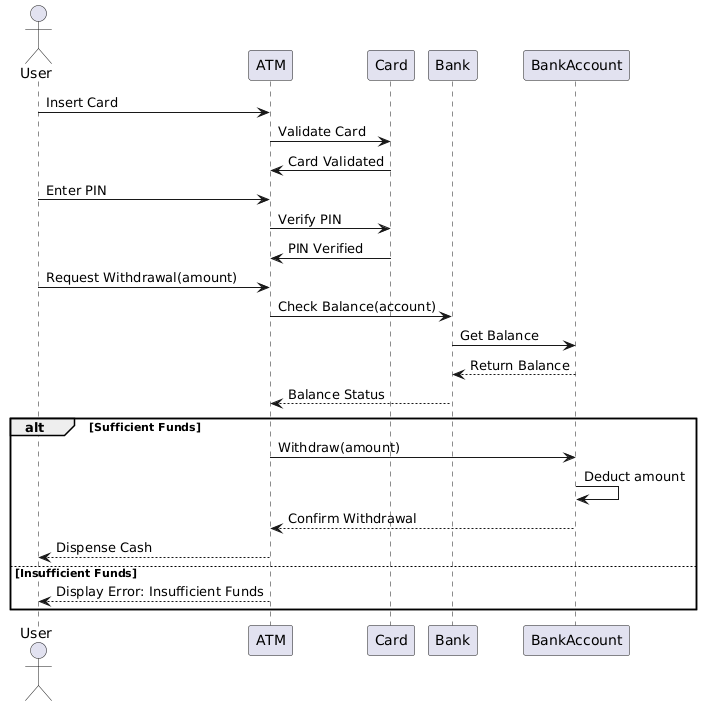
Introduction This case study focuses on the ATM withdrawal process, illustrating how a user interacts with an ATM to withdraw cash. The UML Sequence Diagram provides a visual representation of the interactions between the user, ATM, card, bank, and bank account. This case study will explain the key concepts of UML Sequence Diagrams and interpret […]

Continue Reading

Comparing BPMN and UML Activity Diagrams: Advantages of BPMN for Business Process Modeling

When comparing BPMN (Business Process Model and Notation) with UML Activity Diagrams, several advantages make BPMN more suitable for certain types of modeling, particularly in the context of business processes. This guide provides a comprehensive breakdown of these advantages, along with examples to illustrate when and why BPMN might be the better choice. Additionally, we […]

Continue Reading

Comprehensive Tutorial: UML Activity Diagrams vs. BPMN for Business Process Modeling

Modeling business processes is a critical task for organizations aiming to optimize their operations, improve efficiency, and ensure clarity in workflows. Two popular tools for this purpose are UML (Unified Modeling Language) activity diagrams and BPMN (Business Process Model and Notation). While both can be used to model business processes, they serve different purposes and […]

Continue Reading

Comprehensive Guide to UML for Beginners

Unified Modeling Language (UML) is a powerful tool for visualizing and designing software systems. It provides a standardized way to create blueprints for software, making it easier to understand, design, and communicate complex systems. This guide will introduce you to the basics of UML, focusing on the most practical diagrams for beginners: use case diagrams, […]

Continue Reading

Navigating the Intersection of UML and Agile: Strategies for Effective Integration

Combining UML (Unified Modeling Language) with Agile methodologies can significantly enhance software development processes by providing a structured approach to modeling while maintaining the flexibility and iterative nature of Agile. However, integrating these two approaches is not without its challenges. Teams often face pitfalls such as the time-consuming nature of UML diagrams, the complexity of […]

Continue Reading

Enhancing UML Utilization in Agile Modeling through Iterative Development

Unified Modeling Language (UML) serves as a standardized framework for visualizing, specifying, constructing, and documenting the components of software systems. In Agile software development, integrating UML through iterative development processes offers several advantages. This approach enhances object design, facilitates learning through case studies, and supports the agile application of the Unified Process (UP). By embracing […]

Continue Reading

Integrating UML into Agile Software Development: A Comprehensive Guide

Unified Modeling Language (UML) is a standardized modeling language that offers a set of diagrams to specify, visualize, construct, and document the artifacts of software systems. In the context of Agile software development, UML serves as a valuable tool to enhance communication, clarify design decisions, and maintain flexibility throughout the development process. The Role of […]

Continue Reading

Sequence Diagram Case Study: A comprehensive Approach

Introduction Understanding how different components in a system interact over time is essential for designing robust, efficient systems. Sequence diagrams provide a clear and visual representation of the order in which interactions occur. Whether you’re modeling user interactions at an ATM or detailing backend processes within an enterprise application, these diagrams break down complex flows […]

Continue Reading

Designing Efficient ATM Systems: A Comprehensive Use Case Diagram Approach

Introduction The Automated Teller Machine (ATM) is a critical component of modern banking, providing customers with convenient access to their funds and account information. To effectively design and implement an ATM system, it is essential to understand the various interactions between users and the machine. A use case diagram is a valuable tool in this […]

Continue Reading

Modeling Dynamic Behavior in an Online Bookstore System Using UML Activity Diagrams

Introduction In this example, we will model the dynamic behavior of an online bookstore system using an activity diagram. The online bookstore system allows customers to browse books, place orders, manage their profiles, and leave reviews. The system also manages inventory, processes payments, and handles shipping. This example will illustrate how activity diagrams can solve […]

Continue Reading