


Introduction
For agile teams, speed and clarity are paramount. As we shift towards “Diagram as Code” methodologies to ensure version control, reproducibility, and seamless integration into our CI/CD pipelines, we often encounter a hidden bottleneck: syntax friction. For product managers, architects, and developers alike, the mental context switch required to debug diagram code can disrupt the flow of innovation. A single misplaced character shouldn’t halt a sprint review or delay architectural decisions.
Visual Paradigm’s VPasCode redefines this experience by embedding advanced artificial intelligence directly into the diagramming workflow. By transforming error resolution from a manual, frustrating debugging task into an automated, intelligent process, VPasCode allows agile teams to focus on design logic and business value rather than syntactic precision. This case study explores how VPasCode’s AI-driven auto-fix feature streamlines the user experience, ensuring that diagrams render correctly and efficiently, keeping your team’s momentum intact.
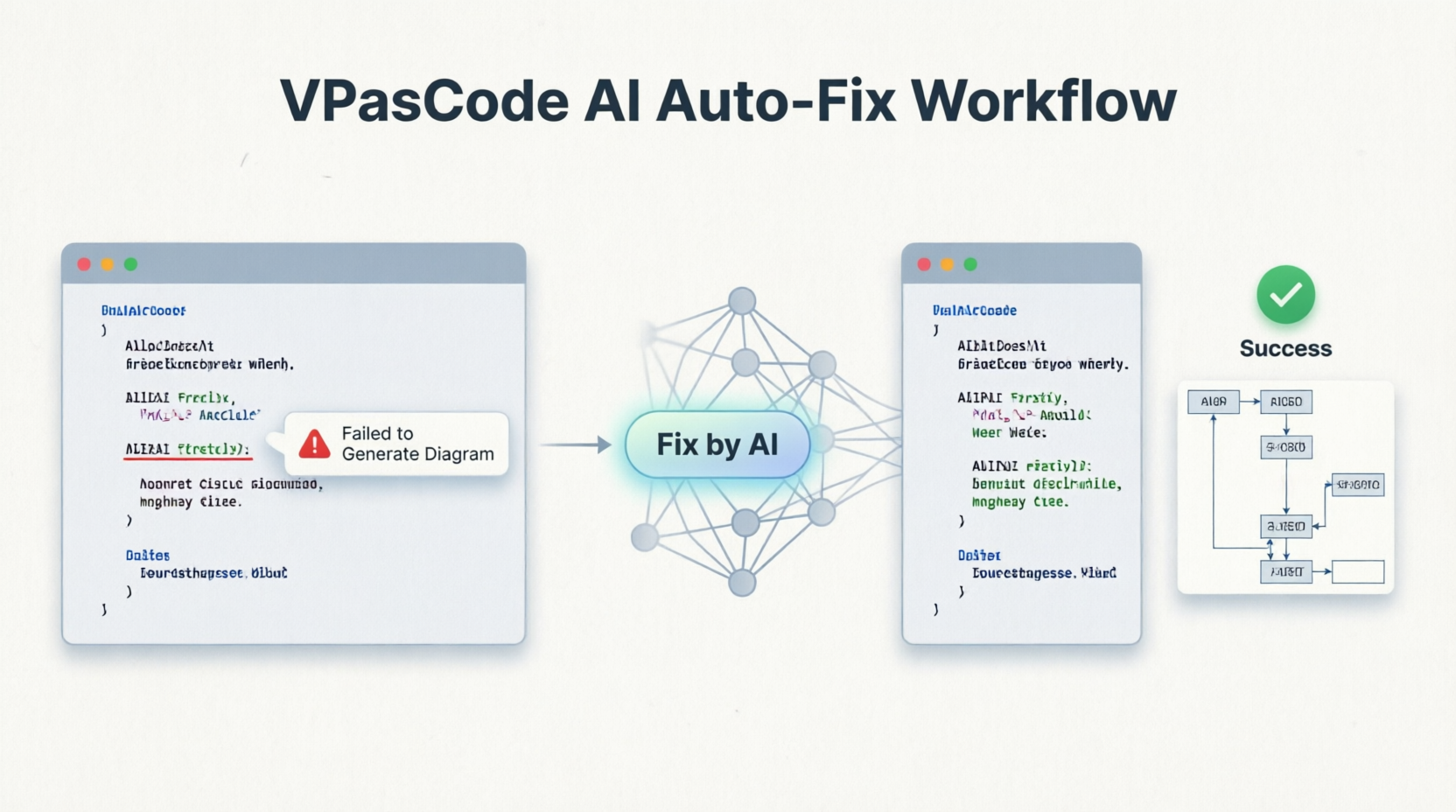
The Challenge: Syntax Errors in Diagram as Code
Traditional text-to-diagram tools demand a high cognitive load. Users must memorize specific syntax rules for connections, shapes, and layouts. In a fast-paced agile environment, this creates friction. A single invalid operator can prevent a diagram from rendering, resulting in generic error messages that offer little guidance.
This friction has two negative impacts on agile teams:
-
Discourages Adoption: Non-technical stakeholders, such as product owners or business analysts, may feel excluded from the documentation process due to the technical barrier.
-
Slows Down Experts: Even experienced developers lose valuable time switching context between coding logic and visual verification, reducing overall velocity.
The Solution: VPasCode’s AI Auto-Fix Workflow
VPasCode introduces a seamless, AI-powered intervention system that detects, analyzes, and corrects syntax errors in real-time. Below is a comprehensive breakdown of the user journey when encountering and resolving a syntax error, demonstrating how quickly teams can get back on track.
Step 1: Immediate Detection of Syntax Error
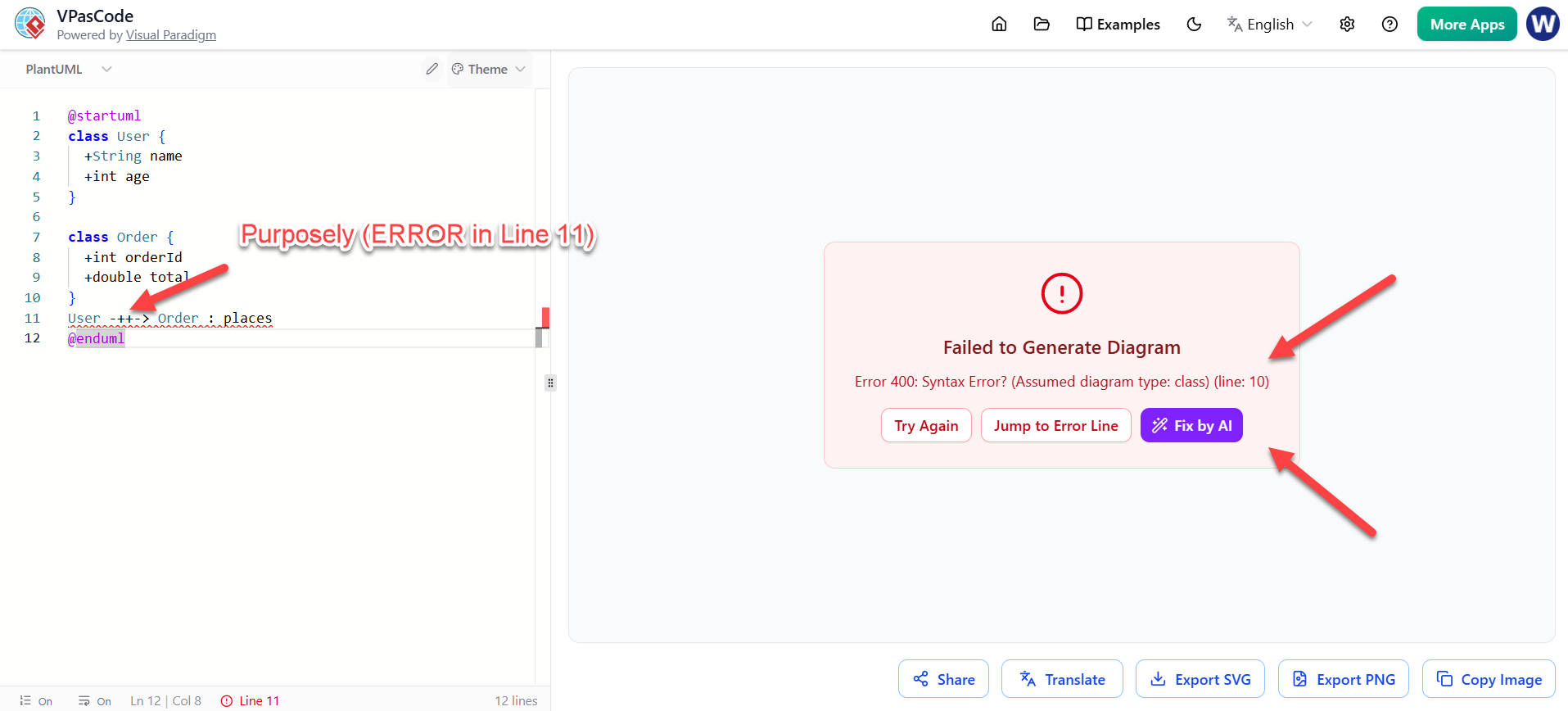
The process begins the moment code is entered. VPasCode’s engine continuously monitors input for validity. When a syntax error occurs—such as an invalid connection operator—the application does not simply fail silently. Instead, it provides immediate, actionable feedback.
-
Visual Alert: The application displays a clear “Failed to Generate Diagram” alert.
-
Precision Targeting: The error message identifies the specific line number where the issue occurred (e.g., Line 11), allowing users to pinpoint the problem instantly without scanning the entire codebase.
Step 2: Initiating the AI Fix
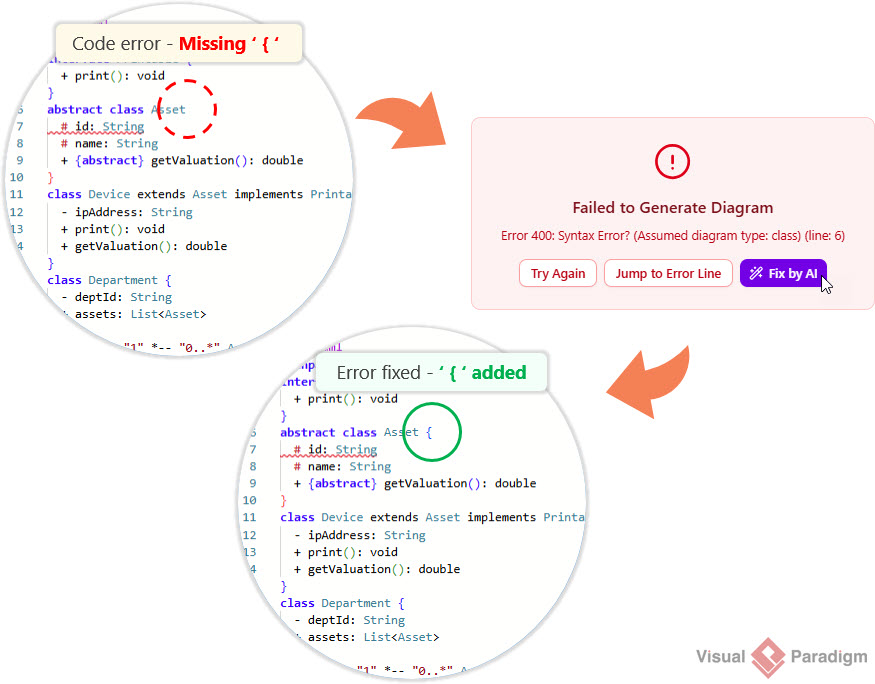
Rather than forcing the user to consult external documentation or manually troubleshoot the syntax, VPasCode offers an intelligent one-click solution. This is crucial for maintaining sprint momentum.
-
Actionable Interface: Within the error notification dialog, a prominent “Fix by AI” button is available.
-
User Empowerment: This feature empowers users of all skill levels to resolve complex syntax issues without needing deep knowledge of the underlying diagramming language, fostering better collaboration across cross-functional teams.
Step 3: AI Analysis and Processing
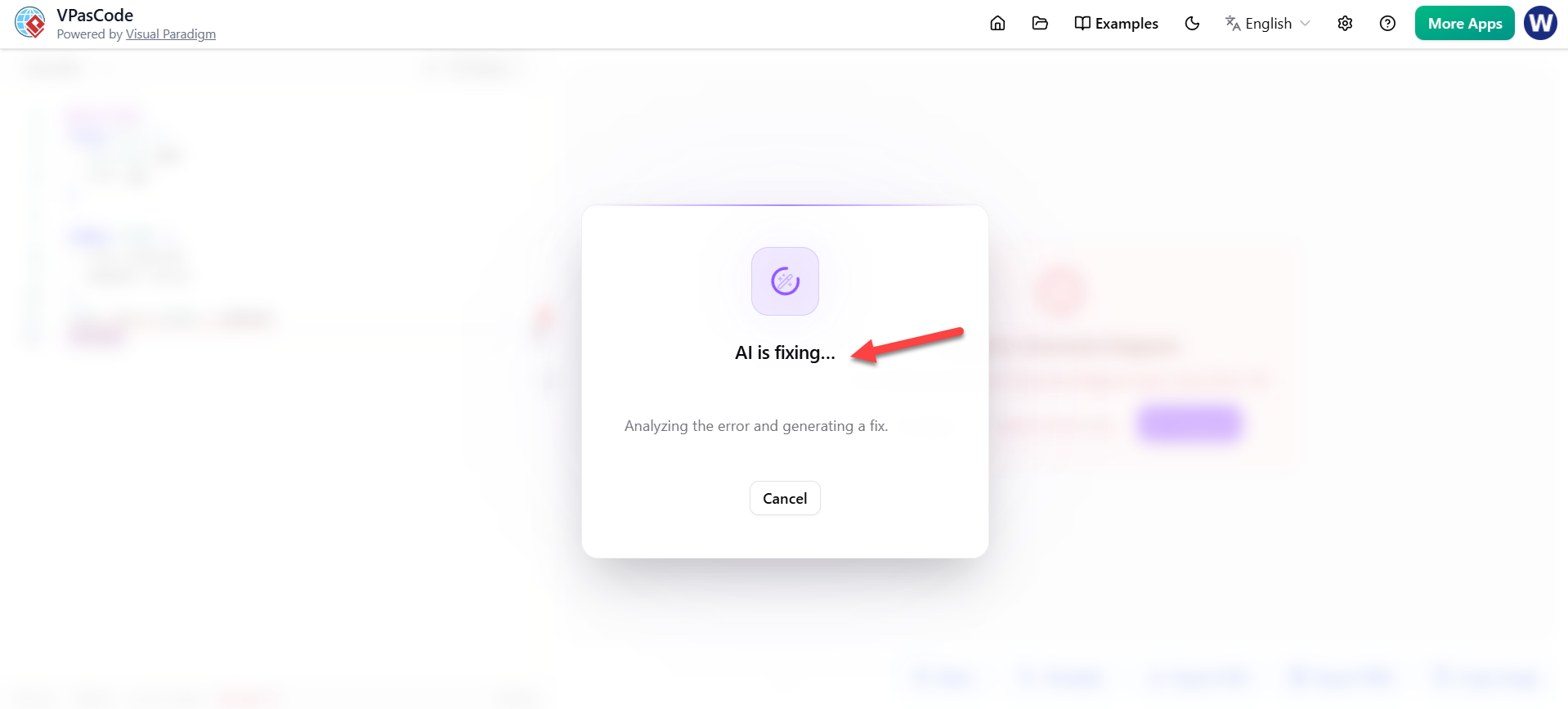
Once the user engages the feature, VPasCode’s AI engine takes over. The system performs a rapid analysis of the erroneous code segment, comparing it against valid syntax patterns and contextual diagram requirements.
-
Transparent Process: A modal window labeled “AI is fixing…” appears, providing visual confirmation that the system is actively working on a solution.
-
Intelligent Reasoning: The AI does not just guess; it understands the structural intent of the diagram to generate a syntactically correct and logically sound replacement.
Step 4: Resolution and Verification
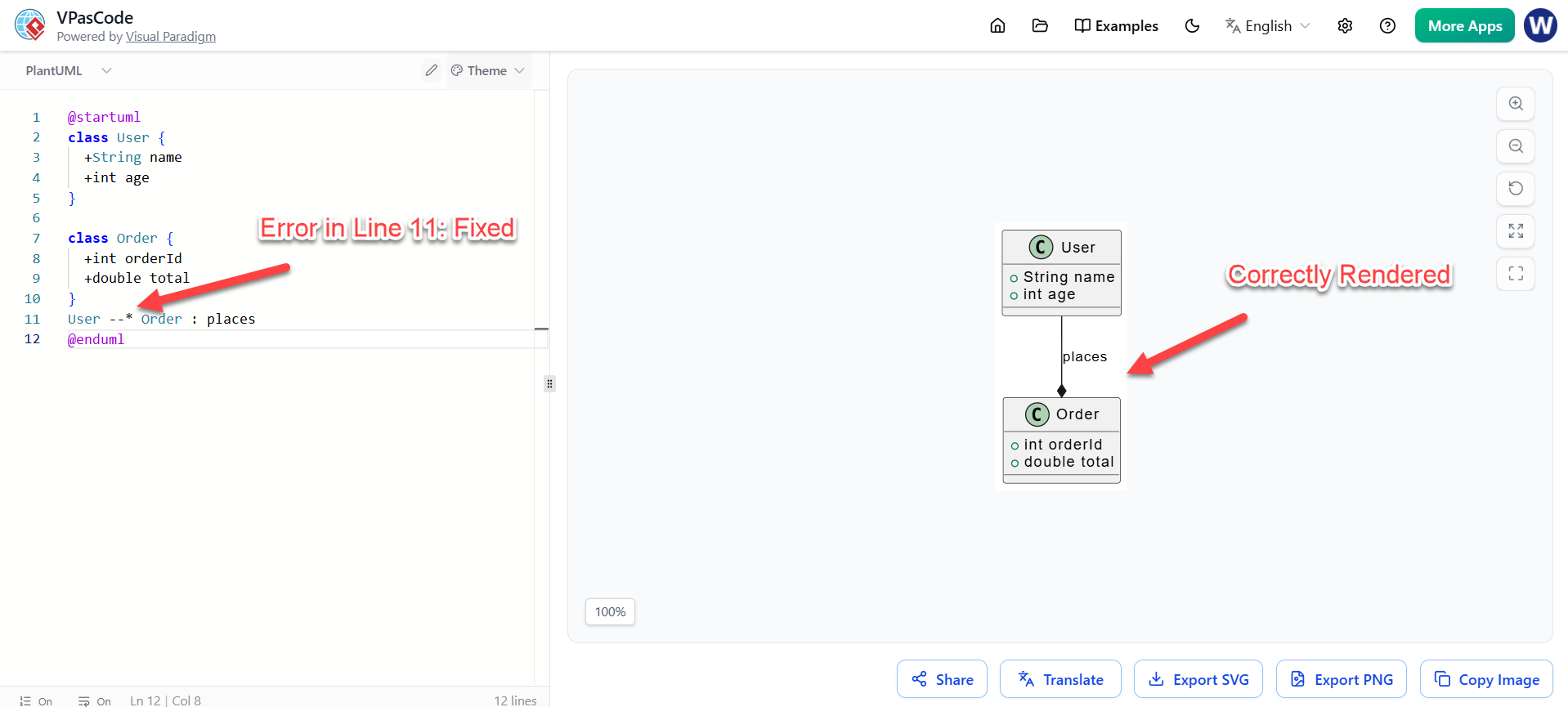
The final step is automatic and seamless. Once the AI completes its analysis, the editor updates in real-time, allowing the team to immediately verify the output during stand-ups or refinement sessions.
-
Automatic Code Correction: The problematic code on the identified line (e.g., Line 11) is replaced with the correct syntax.
-
Instant Rendering: The diagram is immediately regenerated and rendered in the preview pane.
-
Confirmation: The absence of error messages and the successful display of the diagram confirm that the issue has been fully resolved, allowing the user to continue their work without interruption.
Benefits for Agile Teams
-
Reduced Cognitive Load: Team members no longer need to memorize every syntax rule, lowering the barrier to entry for Diagram as Code and enabling broader participation in architectural discussions.
-
Increased Velocity: Time spent debugging is minimized, allowing teams to iterate on designs faster and keep pace with rapid development cycles.
-
Enhanced Accuracy: AI-driven corrections reduce the risk of human error, ensuring that diagrams are both syntactically valid and visually accurate, which is critical for reliable documentation.
-
Improved Collaboration: The proactive and supportive nature of the AI assistant creates a more forgiving and user-friendly environment, encouraging non-technical stakeholders to engage with technical artifacts.
Conclusion
VPasCode’s AI Auto-Fix feature represents a significant leap forward in the usability of Diagram as Code tools, specifically tailored for the needs of modern agile teams. By intelligently handling syntax errors, Visual Paradigm has removed one of the biggest friction points in technical documentation and architecture design. This innovation not only accelerates the creation of high-quality diagrams but also makes the process accessible to a broader range of professionals, from product managers to software architects. As AI continues to integrate deeper into development workflows, tools like VPasCode set a new standard for efficiency, accuracy, and user-centric design, ensuring that your team’s focus remains on delivering value, not debugging syntax.
Reference List
Comprehensive Guide to VPasCode by Visual Paradigm: A detailed overview of VPasCode features, including syntax handling and AI integration.
Introducing VPasCode: The Ultimate Unified Text-to-Diagram Platform: Official release notes introducing VPasCode and its core capabilities.
Clarity by Design: Streamlining Infrastructure Documentation with VPasCode and Graphviz: A guide on using VPasCode for infrastructure documentation with Graphviz support.
Mastering VPasCode: The Ultimate Guide to AI-Powered Diagram as Code with Multi-Engine Support: An advanced guide covering AI features and multi-engine support in VPasCode.
How the Visual Paradigm AI Chatbot and VPasCode Function as an Integrated Ecosystem for Diagramming: Insights into the integration between VPasCode and Visual Paradigm’s AI chatbot.
VPasCode Features Overview: A summary of key features offered by VPasCode.
Break Language Barriers Natively with VPasCode’s New AI Diagram Translation: Release notes on AI-driven diagram translation capabilities.
Case Study: Accelerating Software Architecture Documentation with VPasCode – A Diagram as Code Revolution: A real-world case study demonstrating the impact of VPasCode on software architecture documentation.
Related posts:
 AI-Powered UML Diagrams: How to Generate Complete Software Models in Minutes with Visual Paradigm
From Text to Visuals: A Hands-On Review of VPasCode for Modern Engineering Teams
AI-Powered UML: Supercharging Agile Modeling in the Age of Intelligent Design
AI-Powered UML Diagrams: How to Generate Complete Software Models in Minutes with Visual Paradigm
From Text to Visuals: A Hands-On Review of VPasCode for Modern Engineering Teams
AI-Powered UML: Supercharging Agile Modeling in the Age of Intelligent Design
 UML Modeling in Agile Development: The AI and Diagram-as-Code Revolution